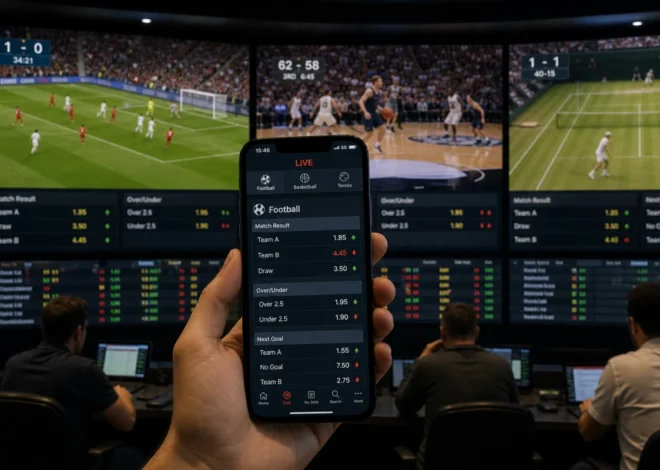

Live Betting Lines Explained: Strategies for Smarter In-Play Bets
Why live betting lines matter for every in-play decision
When you place a bet after kickoff, tip-off, or the first serve, you enter a faster, more reactive market than pre-match wagering. Live betting lines are not static: they change as the game unfolds, reflecting scoring swings, injuries, momentum shifts, and new information. Understanding how those lines are set and why they move helps you separate noise from genuine edge, so you can make clearer, faster choices under pressure.
In-play markets reward speed and context. You’ll frequently see odds shorten or lengthen within seconds after a key event. If you don’t know what triggered that shift — whether it’s a red card, an injury time sub, a sudden scoring run, or a stat that bookmakers weight heavily — you risk reacting to volatility rather than value. This section gives you a framework to read live lines and spot the signals that matter.
What live odds represent and how to read them
Live odds represent the bookmaker’s current assessment of likelihood for a specific outcome given everything known at that moment. Unlike pre-match lines, they fold in real-time variables: current score, remaining time, possession stats, foul trouble, and even crowd behavior. You should view them as dynamic probabilities rather than fixed predictions.
- Decimal, fractional, or American formats: know your preferred format so you can convert quickly in your head when odds are shifting.
- Implied probability: mentally convert odds to percentage chance (or use a quick calculator) to compare against your own read of the situation.
- Line drift vs. line compression: drift indicates shrinking bookmaker confidence in an outcome; compression (odds shortening) suggests fresh money or important events favoring that result.
Key factors that move live betting lines
Bookmakers update live lines using a mix of automated models and trader oversight. You should pay attention to the most common drivers of movement so you can anticipate or react sensibly:
- Game-state variables: score margin, time remaining, possession, and timeouts directly alter win probability models.
- Player availability and fatigue: substitutions, injuries, and foul trouble are weighted heavily in short-term markets.
- Market flow and balance: bookmakers may shift lines to balance exposure if one side attracts disproportionate money.
- Public sentiment and momentum: obvious runs (e.g., a sudden 10–0 stretch) can cause rapid odds compression even when fundamentals haven’t changed.
By tracking these elements, you can distinguish between noise — short-lived volatility you should avoid — and structural shifts that create real betting opportunities. In the next section, you’ll learn practical in-play strategies, timing techniques, and bankroll rules that turn this understanding of live lines into smarter bets.
Practical in-play strategies that exploit line movement
Having a handful of repeatable strategies keeps emotion out of fast-moving markets. Use these playbooks as templates rather than rigid rules — adapt them to the sport, your edge, and the specific live context.
- Scalp short-lived inefficiencies: Look for brief mismatches after obvious events. A red card or an early injury often creates a window where public reaction outpaces model adjustments. Small, quick bets — often on moneyline or next-score markets — can lock in tiny edges repeatedly.
- Fade exaggerated momentum: When lines compress dramatically on an obvious run, question whether fundamentals changed enough to justify the move. If your read and live metrics (possession, quality shots, time remaining) don’t support the swing, a small contrarian bet can pay off when odds normalize.
- Target structural shifts, not noise: Bet when substitutions, fatigue indicators, or foul trouble produce durable changes in win probability. These create longer-lasting line moves that are less likely to be reversed by heat-of-the-moment bettors.
- Middles and hedges: Use pre-match positions to create in-play middle opportunities. If you hold a pre-match spread and the live line moves across your originally taken number, you can win both sides or lock profit by hedging selectively.
- Prop and micro-market exploitation: In-play props (next point scorer, next corner) are more driven by immediate data and trader oversight. They can be inefficient for precise, short-duration reads — especially if you follow player substitution patterns closely.
Timing, sizing, and bankroll rules for live bets
Speed without discipline is a recipe for ruin. In-play betting demands strict rules for when to act and how much to risk so variance doesn’t blow up your bank.
- Unit sizing by market type: Adopt smaller unit sizes for volatile, micro-markets (props, next-score) — typically 0.5–1% of bankroll — and modestly larger units for durable probability shifts in primary markets (1–2%).
- Limit exposure per game: Cap total exposure on a single event (e.g., 5–8% of bankroll) to avoid catastrophic losses during rare collapses or sharp bookmaker reactions.
- Use fractional Kelly where possible: If you can estimate edge, apply a fractional Kelly (10–25% of full Kelly) to balance growth with drawdown protection. When edge is unclear, default to flat betting instead of overleveraging.
- Predefine stop-loss and take-profit rules: Set mental or app-based thresholds to close positions if losses reach a fixed percentage of your exposure, and consider partial cash-outs to bank profit when lines move in your favor but upside is uncertain.
- Shop lines and monitor limits: Always compare live lines across books; quick line-shopping reduces juice and lets you scale size at better prices. Be mindful that repeated in-play winners may trigger quicker limits from some sportsbooks.
Tools, data feeds, and second-screen habits that improve decisions
Winning in-play requires superior information and low-latency habits. Treat your setup like a cockpit: the right instruments and workflow shorten reaction time and reduce mistakes.
- Live stats dashboards: Use sites that provide possession, expected goals, shot quality, and player tracking. Numbers that quantify momentum are more reliable than subjective feel.
- Fast, legal streams and audio feeds: Visual confirmation of substitutions, injuries, and tempo matters. Stream latency can vary — use providers known for low-delay broadcasts.
- Line trackers and alerts: Set alerts for rapid odds moves and unusual volume. Knowing which line moved first (model vs. market) helps you interpret the cause.
- Multiple books on one device: Keep at least two or three books signed in to compare prices and cash-out options instantly. Mobile ergonomics (quick stake presets, one-click bet) matter under pressure.
Combining disciplined strategy, strict bankroll rules, and a data-driven second-screen routine turns the chaos of live markets into repeatable opportunities. In the next part, we’ll cover advanced reads, behavioral traps to avoid, and how to measure your in-play edge over time.
Advanced reads, behavioral traps, and measuring your in-play edge
Beyond the basics, profitable live bettors develop a set of nuanced reads and clear rules to avoid common psychological pitfalls. Treat these as ongoing practices you refine rather than one-off tricks.
-
Advanced reads: Track short-term metrics that feed into win-probability models: expected goals (xG) differentials, turnover timing, possession in the final third, shot quality, and substitution patterns. Combine these with contextual signals — e.g., late-game strategic fouls or bench rotations — to judge whether a line move is transient or structural.
-
Market signals vs. model signals: Distinguish whether odds moved because traders/models adjusted or because public money pressed a price. If models and live stats align with the move, the change is likelier to persist; if not, the move can be fadeable.
-
Behavioral traps to avoid: Recency bias (overweighting the last few minutes), chase risk after losses, and confirmation bias (seeking evidence that fits a pre-made bet). Enforce pre-set unit sizes, stop-loss rules, and a maximum number of trades per event to limit emotional escalation.
-
Measuring edge and iterating: Keep a detailed log: event, market, odds in/out, stake, result, expected value estimate, and closing-line value. Evaluate over meaningful sample sizes and focus on metrics that matter — ROI per market type, closing-line beat rate, and variance-adjusted returns — then iterate your strategy accordingly.
Putting the toolkit to work
Start small, treat in-play betting as a research-and-development process, and prioritize discipline over short-term thrills. Build repeatable workflows: real-time data sources, quick line checks across books, predefined staking rules, and rigorous record-keeping. Over time, the combination of smarter reads, disciplined sizing, and constant testing produces sustainable advantage — if you remain patient and honest about what the data tells you. For practical modeling ideas and public-facing work on live probabilities, see FiveThirtyEight.
Frequently Asked Questions
How fast do live betting lines update after a major event?
Update speed varies by sportsbook and market. Automated models can change lines within seconds, while trader-reviewed markets may lag slightly as humans confirm context. For major, quantifiable events (goals, red cards, confirmed injuries), expect odds to move almost immediately; for subtler developments (fatigue patterns, tactical shifts), lines may adjust over one to several minutes as data accumulates.
What staking approach is safest for in-play markets?
Use smaller unit sizes than you would pre-match, especially for high-volatility micro-markets. Typical guidance is 0.5–1% of bankroll for props and next-score markets, 1–2% for primary market bets with clear durable edges, and a capped exposure per event (e.g., 5–8% of bankroll). Apply fractional Kelly if you can estimate edge reliably; otherwise prefer flat, conservative sizing.
How can I tell if a live line move presents real value or just public noise?
Compare the move to live metrics and model signals: if possession, shot quality/xG, player availability, or confirmed tactical changes support the shift, it’s more likely structural. If the move is driven by rapid betting volume without corresponding live-stat changes, it’s often noise caused by public momentum and can be fadeable. Cross-check across books and watch whether models or sharp books lead the change — model-led moves carry more informational weight.

Related Posts
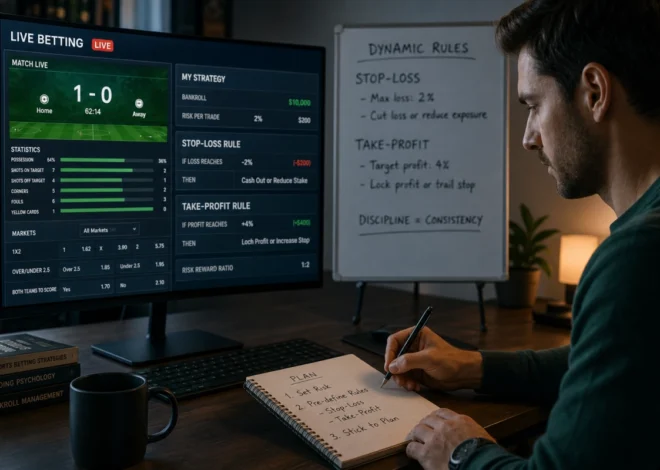
A practical guide to pre-defining and applying dynamic stop-loss and take-profit rules for live betting bankroll management

How to find the best live betting odds in-play: tools, latency and smart execution