How to Compare Betting Odds for Live Matches and In-Play Markets
Why live-match odds shift and why that matters to you
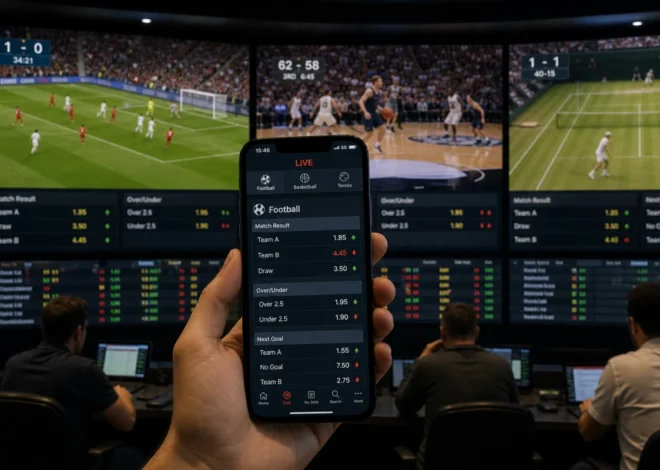
When a match is underway, odds move quickly in response to events: goals, injuries, momentum swings, and referee decisions. You need to understand the reasons behind those shifts so you can spot opportunities and avoid impulsive wagers. Live markets are driven by real-time information and bookmaker risk management; the same event can produce different reactions across bookmakers, creating potential value if you act fast.
Think of live odds as a continuous negotiation between supply (bookmakers’ liability) and demand (bettor activity), filtered through new information. If you know what information matters most for a given sport or market, you’ll be better placed to predict whether odds will drift or shorten and to compare prices across sites efficiently.
Key live-market drivers to watch
- Match events: Goals, red cards, substitutions, and injuries generally have the largest immediate impact.
- Momentum and possession: Sustained pressure or a run of corners can nudge odds even without a decisive event.
- Market exposure: Heavy betting on one outcome can force a bookmaker to adjust prices to balance liability.
- Latency and feed differences: Different data feeds and update speeds mean you may see odds change on one site before another.
How to read in-play markets quickly and accurately
In-play markets are numerous: match winner, next goal, total goals, handicaps, and many micro-markets. You’ll need a decision framework that lets you assess odds without getting overwhelmed. Start by prioritizing markets where you have the strongest edge or easiest lines to interpret—commonly match result, next goal, and simple over/under totals.
Use a checklist before placing a live bet: confirm the current score and time, check team news (substitutions and injuries), review recent possession and shots data, and compare the best available odds across at least two bookmakers or an odds aggregator. If the market moved sharply on an event you already anticipated, the best price may have disappeared; if it hasn’t, you may have found value.
Fast comparison techniques
- Open two or three bookmaker apps/tabs you trust and watch how each reacts in the first 30 seconds after a big event.
- Use an odds-comparison tool or API when possible to see side-by-side prices for the same market.
- Set price alerts for specific odds levels so you don’t need to stare at screens all match long.
With these basics you’ll be able to prioritize which live markets to follow and how to make split-second comparisons. In the next part, you’ll learn practical workflows and the best tools to aggregate live odds across bookmakers and identify profitable discrepancies.
Practical workflow: compare and act in under 30 seconds
When the match is live you don’t have time for analysis paralysis. Adopt a rehearsed, repeatable workflow so comparing odds becomes muscle memory.
1. Pre-match prep (2–5 minutes)
– Pre-load two or three bookmaker tabs/apps and one odds-aggregator or exchange screen for the markets you prefer (match winner, next goal, total).
– Set price alerts where possible and note the latency differences between each source (which one updates fastest for this match).
2. Immediate reaction (0–10 seconds after an event)
– Glance at score/time, then check your two primary feeds. If one book shortens markedly while others lag, you may have a fleeting edge.
– Apply a simple threshold rule: only act if the best available price is X% (e.g., 5–10%) better than the market average or your fair-price model.
3. Quick context check (10–20 seconds)
– Confirm the event drivers: was the goal offside? Is a key player being subbed? If uncertainty exists, pause—reacting to bad information is a common trap.
4. Execution (20–30 seconds)
– If the edge holds, place the wager on the site offering the best price. If you use an exchange, size the trade so you can hedge or lay off quickly if the market reverses.
5. Post-action control
– Immediately set an exit rule: acceptable loss, target profit, or a condition to hedge. Log the bet outcome and rationale for later review.
Rehearse this workflow in low-stakes situations until it’s automatic. The decision speed that matters most is the one backed by a clear, pre-defined process—not by impulse.
Tools and platforms that speed up live odds aggregation
Not all tools are equal for in-play work. Choose a stack that balances speed, reliability, and the markets you trade.
– Odds aggregators: Good aggregators give side-by-side prices across multiple bookmakers and flag quick movements. They’re great for spotting disparities but may have variable update speeds—verify latency before relying on them for fast trades.
– Betting exchanges: Exchanges (liquidity venues) let you both back and lay; they’re essential for hedging and scalping. Market depth matters—thin liquidity can make execution expensive or impossible.
– Trading terminals and bots: Dedicated trading platforms provide streaming price charts, ladders, and one-click execution. Automated bots can execute strategies faster than manual trading but require rigorous testing and safeguards.
– APIs and data feeds: If you build custom tools, use websocket APIs for real-time updates rather than polling. Commercial feeds (e.g., sports-data providers) are pricier but far more consistent for professional use.
– Latency and hosting solutions: For critical speed, use a VPS close to bookmaker servers, and prefer wired connections. Measure round-trip times to each source frequently.
– Alerting and workflow extensions: Browser extensions, mobile push alerts, and webhooks let you react even when you’re not staring at screens. Configure only high-signal alerts to avoid fatigue.
When evaluating tools, test them in live matches before committing money. Reliability under load (busy fixtures) is the true litmus test.
Execution, staking and in-play risk controls
Live markets can amplify both gains and losses—controls prevent small mistakes from becoming large ones.
– Staking rules: Use small fixed units or a conservative fraction of your flat stake per trade. Avoid aggressive Kelly formulas during fast-moving in-play markets unless your edge and variance estimates are robust.
– Stop-loss and profit targets: Predefine maximum allowable loss and a profit target for each in-play trade. If either is hit, act without hesitation.
– Liquidity awareness: For exchanges, check available amounts at the price. If liquidity is thin, reduce stake or split orders to avoid large market impact.
– Hedging and partial cashouts: If the market moves against you but your model still sees value, consider partial hedges to reduce exposure while keeping upside.
– Limits and session caps: Cap the number of live bets per match and total exposure across simultaneous matches to control correlation risk.
– Record keeping and review: Log every live trade with the trigger, expected edge, stake, execution price and outcome. Regular review separates skill from luck and improves future decisions.
Applied consistently, these controls let you exploit brief in-play edges without exposing your bankroll to avoidable blow-ups.
Putting this into practice
Live betting rewards preparation, repetition and clear rules more than intuition. Before you increase stakes, rehearse the 30-second workflow in low-risk settings, test your toolset under real match load, and confirm which data feed updates fastest for the fixtures you trade. Treat technology as part of your edge—measure latency, use one-click execution where appropriate, and host critical tools on a reliable connection or VPS.
Keep discipline simple: a fixed staking plan, strict stop-loss/profit rules, and a cap on simultaneous in-play exposures. Review every live trade in a short log (trigger, execution, outcome) and iterate on the smallest errors first—latency mismatches, misreads of momentum, or execution slippage are common and correctable.
Finally, keep learning. Read trading post-mortems, follow reputable resources on market microstructure, and test new strategies at small sizes before scaling. If you want a primer on odds, probability and how bookmakers price markets, you can learn more about odds and probability from an industry guide.
Frequently Asked Questions
How quickly do I need to act when odds shift after an event?
Speed matters, but measured speed is better than frantic reactions. Use the 30-second workflow: quick scan of score/time, check two primary feeds for price discrepancy, confirm the event context, then execute if the edge meets your predefined threshold. If you can’t complete these steps within your threshold window reliably, reduce stakes or rely on alerts/automation.
Which in-play markets are easiest to compare and trade?
Start with simple, liquid markets: match result (1X2), next goal, and basic over/under totals. These markets are widely offered, have deeper liquidity on exchanges, and are easier to model quickly. Micro-markets can offer opportunities but often have more noise, higher margins, and thinner liquidity—tackle them after you’re consistently profitable on core markets.
How do I handle latency differences between bookmakers and data feeds?
First, measure update speeds before committing real money and note which sources update fastest for your events. Use websocket feeds or trading terminals with proven low latency, consider a VPS near bookmaker servers, and set alerts on the fastest feed while verifying prices on backup feeds. When latency is unavoidable, reduce stake sizes and widen your edge threshold to compensate for execution risk.

Related Posts
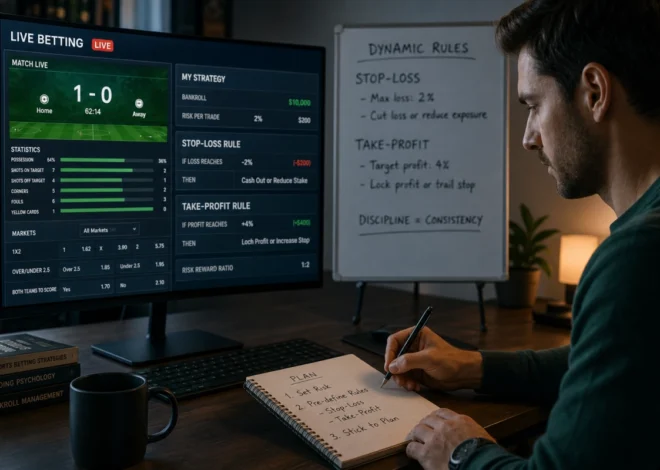
A practical guide to pre-defining and applying dynamic stop-loss and take-profit rules for live betting bankroll management
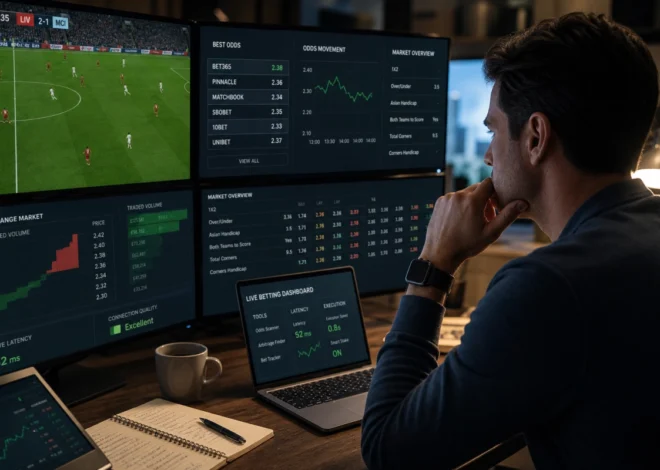
How to find the best live betting odds in-play: tools, latency and smart execution