A Practical Step-by-Step Guide to Building a Repeatable Live Betting Bankroll System
Build a repeatable live betting bankroll system that works in-play
What “live betting bankroll management” means and why it matters
Live betting bankroll management is the disciplined framework a bettor uses to protect their bankroll and make repeatable decisions during in-play markets. In-play odds move rapidly as momentum, substitutions, fatigue or injuries shift expectations. A clear system helps the bettor react fast without chasing losses or making emotional bets.
Key in-play terms:
- Live odds — current prices during a match reflecting real-time probability.
- In-play markets — markets available during the match (next goal/point, next scorer, match-winner, totals, corners, etc.).
- Cash out — offered settle-now value to lock profit or cut losses.
- Match momentum — flow of a game (possession, runs, pressure) that shifts live odds.
- Handicap / totals — common live markets that adjust to match state and can offer value if momentum is read correctly.
First steps: bankroll size, session budgets and preset limits
Start by separating a dedicated live-betting bankroll you can afford to lose. From that bankroll, set session budgets — a per-day or per-match cap — to limit exposure and prevent revenge betting.
Suggested basic controls:
- Bankroll (total): an absolute amount exclusively for live betting.
- Session budget: commonly 1–5% of bankroll per live session.
- Stop-loss limit: a hard session loss (e.g., 50% of session budget) that ends activity for the day.
- Max concurrent exposure: limit active live bets at once (1–3 typical).
Stake-sizing models explained (flat, percentage, volatility‑adjusted Kelly)
Stake-sizing determines how much to risk on a single live wager. Practical models:
- Flat staking — same stake every bet. Simple and low-variance; good for novices.
- Percentage staking — wager a fixed percent of bankroll (e.g., 1%). Scales with bankroll but increases volatility in small-bankroll cases.
- Volatility‑adjusted Kelly — fraction of the Kelly criterion adjusted for live volatility and conservative fractional application (e.g., 10–25% of Kelly). Requires reliable edge estimates.
Beginners often start flat or low-percentage staking and move to adjusted Kelly only after consistent tracked results.
Concrete stake‑calculation templates and quick formulas you can copy
Templates to paste into a spreadsheet or phone note. Assumptions: Bankroll B, session budget S = x% of B, max per-bet cap C (commonly 10–25% of S).
1) Flat staking
- Stake_flat = nominated flat amount (e.g., $10).
- Rule: Stake_flat ≤ C. If Stake_flat > C, reduce to C.
2) Percentage staking
- Stake_pct = B × P (P = chosen fraction, e.g., 0.01 for 1%).
- Rule: Stake_pct = min(Stake_pct, C).
3) Volatility‑adjusted Kelly (simplified)
- Inputs: decimal odds O, estimated true probability p, bankroll B.
- Compute b = O − 1, q = 1 − p.
- Raw Kelly f = (b × p − q) / b. If f ≤ 0 → do not bet.
- Apply conservative fraction Fk (0.10–0.25): f_adj = f* × Fk.
- Stake_kelly_raw = B × f_adj. Final stake = min(Stake_kelly_raw, C).
Quick example: B = $2,000; S = 3% = $60; C = 20% of S = $12. Flat $10 allowed. 1% = $20 → capped to $12. Kelly gives ~1.12% → ~$22 → capped to $12. Always enforce C so Kelly or percentage outputs cannot blow session limits.
Preset exit, cash‑out triggers and stop‑loss rules — ready to copy
Establish numeric triggers before the match and stick to them. Program these as simple if‑then rules in your notes or betting app reminders.
Universal templates
- Profit target: cash out if current cash‑out ≥ target_pct × potential_win (common targets: 40–70%).
- Partial lock: cash out when current cash‑out ≥ 50% AND remaining projected win meets desired ROI.
- Stop‑loss per bet: accept full loss or cash out if offered ≤ stop_loss_pct × stake (e.g., 25–40%).
- Session stop‑loss: stop betting when session losses reach L% of S (common L = 50–75%).
- Bankroll drawdown stop: pause betting if cumulative drawdown > D% of bankroll (common D = 10–20%).
Sport examples (short):
- Football (next-goal): stake $12, potential win $30. Preset: cash out at 60% ($18). If a red card or penalty shifts state, reassess or lower cash‑out threshold.
- Basketball (live spread): auto cash‑out at a 40% increase when a team goes on an 8–0 run; lower threshold if a key player is injured.
- Tennis (live set): stake to win next set; auto cash‑out rules change when opponent serves for the set or gains decisive advantage.
Emotional control checklist and in‑play decision flow (copyable template)
Use this 6‑point checklist before every live bet. If any answer is “no,” do not place the wager.
- 1. Does the stake fit my precomputed model and cap?
- 2. Have I verified the edge estimate and market movement?
- 3. Will this bet violate session stop‑loss or max concurrent exposure?
- 4. Am I within X minutes of an emotional trigger (bad beat, long streak)?
- 5. Is my heart rate/urgency elevated? If yes, take 60 seconds to breathe.
- 6. Do I have a clear exit/cash‑out trigger written?
In‑play decision flow (5 steps)
- Observe — 10 seconds: confirm key observable (goal, injury, substitution).
- Re‑estimate p quickly: if edge flips sign, do not bet.
- Apply stake template and cap.
- Set immediate exit trigger (cash‑out % and stop‑loss %).
- Log the bet and set a 5–15 minute cool‑off before the next bet unless a predefined next market arises.
If you break a rule or adrenaline spikes, stop trading for at least 15 minutes and review the log. The system’s repeatability depends on behavioral rules as much as math.
Recordkeeping, review cadence and quick templates to finish your setup
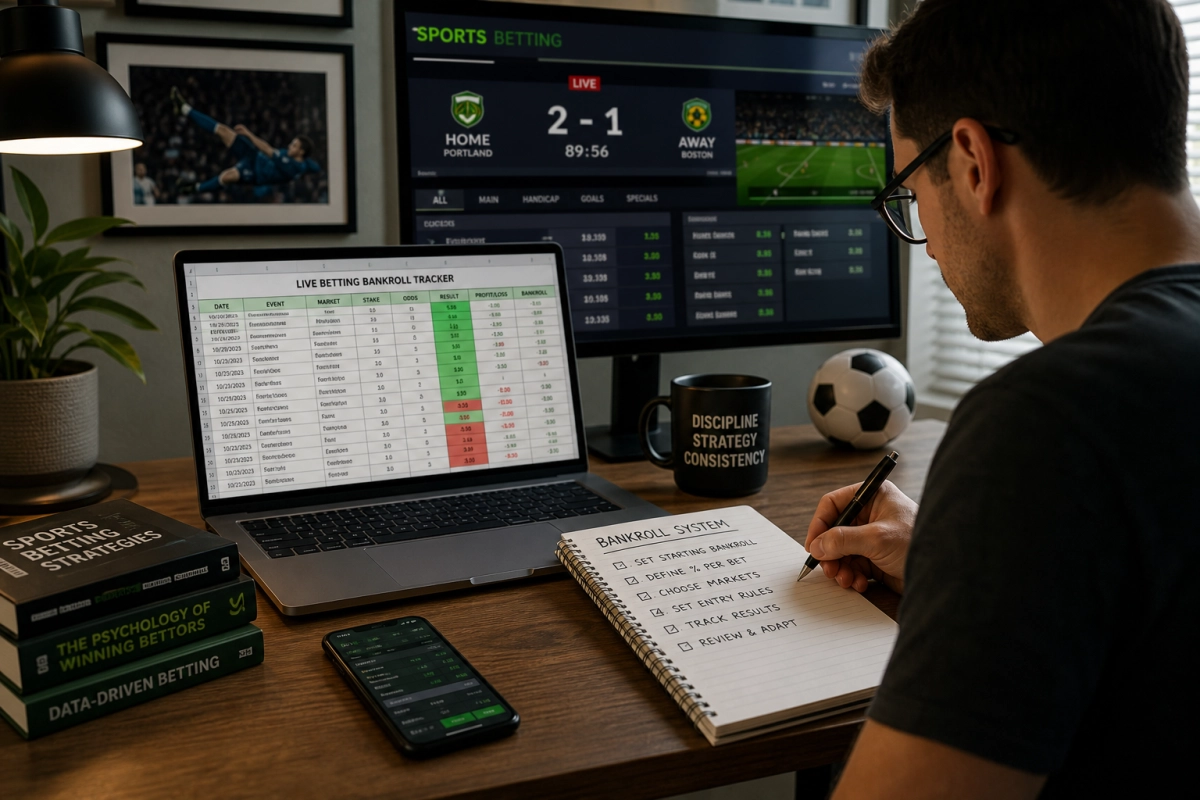
Essential fields to log for every live bet
- Date/time, sport, league, teams/players
- Market and decimal odds
- Pre-bet estimated probability (p) and 1–2 sentence edge rationale
- Stake amount and stake model used
- Preset exit / cash‑out trigger and stop‑loss rule
- Outcome and realized P&L
- Emotional state and rule adherence (yes/no)
- Post-match notes (what changed, market misread, lucky/unlucky event)
Weekly and monthly review checklist
- Compute ROI, hit rate and yield per stake model separately.
- Compare average edge estimates to realized results and adjust calibration.
- Review rule breaches and count incidents with root causes.
- Adjust session budgets and caps based on data, not short-term variance.
- Choose one small, testable change for the next period (edge calibration, session length, stricter stop-loss).
Getting started: a 30‑day rollout plan
- Days 1–3: Set bankroll B, session budget S, and cap C. Paste stake templates into notes. Do dry runs with hypothetical bets.
- Days 4–14: Live trading at reduced stakes (50%). Log every bet and enforce the emotional checklist strictly.
- Days 15–21: First formal weekly review. If Kelly repeatedly hits the cap, investigate edge estimates before changing limits.
- Days 22–30: Move to full stakes if metrics are stable. Continue daily logging and perform a comprehensive 30-day review with concrete adjustments.
Final guidance before you trade live
Treat this system as an experiment with disciplined controls, not as a shortcut to profit. The real work is consistent recordkeeping, honest reviews, and refusing to change rules because of one hot streak or one bad day. Start small, iterate only when justified by data, and protect your ability to play another day by respecting session and bankroll limits. If you do those things, the framework you’ve built will give you the repeatability and emotional guardrails that separate sustainable live betting from impulsive gambling.

Related Posts

How to Find the Best Live Betting Odds During Matches: Bookmakers, Exchanges, Latency and Market Depth

Practical In-Play Betting Bankroll Management: Sport-Specific Rules for Football, Basketball & Tennis