
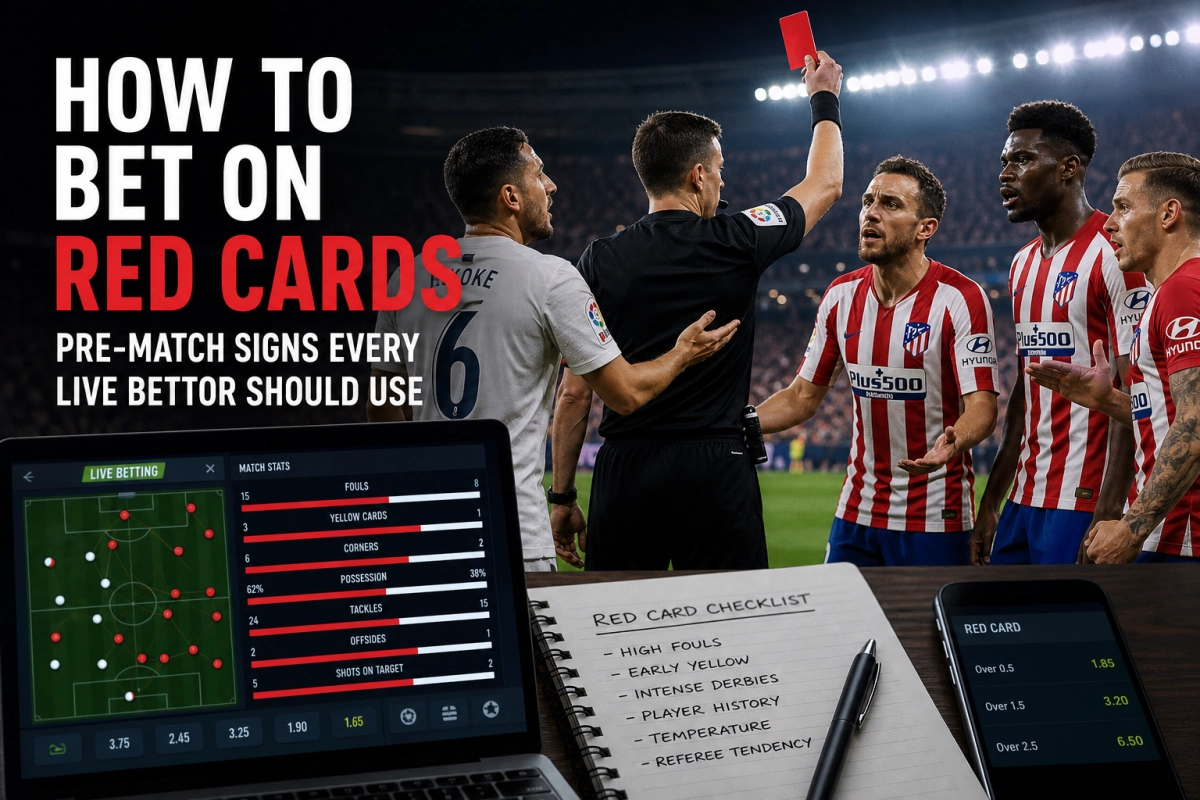
How to Bet on Red Cards in Football: Pre-match Signs Every Live Bettor Should Use
Betting on red cards in football: spotting pre-match edges before kick-off
Betting on red cards in football is a niche live market that rewards attention to context as much as luck. This guide explains what to look for before the match — referee tendencies, team discipline records and match context — and defines essential in-play terms like live odds, in-play markets and cash out so readers know the language used by bookmakers during a game.
Why pre-match analysis matters for red-card markets
Live markets shift quickly once a match starts. A good pre-match read lets a bettor enter in-play with a plan rather than guessing. “Live odds” are the bookmaker prices you see during a match; they move based on events, statistics and market flow. An “in-play market” for red cards can offer prices on total cards, a red for either team, or next sending-off. Understand these before placing money and keep stake sizes disciplined.
Referee profile: the first filter
Referees shape card outcomes. Before betting on red cards, check the referee’s recent matches for:
- Average cards per match (yellow and red) — a higher average raises red-card probability.
- Tendency for strict vs. advantage-led officiating — some refs give fewer bookings and let play continue.
- VAR involvement and overturn rates — referees in competitions with active VAR may see later red cards or upgrades from yellows.
Practical step: keep a short list of referees whose style you understand and track them for a few fixtures before using larger stakes.
Team discipline and player risk
Teams and individual players provide the second layer of context. Useful checks include:
- Recent yellow-card counts and any repeat offenders who risk escalation to a red.
- Aggressive tactical setups — high-press or counter-press teams commit more tackles and risk late challenges.
- Suspension-driven lineup changes — if a team starts a replacement known for poor discipline, red risk can rise.
Example: a derby with several midfield enforcers suspended can force inexperienced players into high-pressure duels, increasing reckless tackles and the chance of a red.
Match context: motivation, competition and timing
Context alters referee decisions and player behavior. Consider:
- Competition importance — cup knockout or relegation battles often see higher tension and stricter officiating.
- Score dynamics likely at certain phases — late-game pressure where a team is chasing a goal can trigger desperate, reckless fouls.
- Weather or pitch conditions — slippery surfaces increase mistimed tackles and accidental studs-up challenges.
Combine these three pre-match pillars into a simple checklist before placing funds: referee fit, team/player discipline, and game context. Also decide stake size in advance (a small, defined percentage of the bankroll) and avoid emotional increases after watching the first 10–15 minutes.
Next, the guide will explain live indicators during the match — tackles, tempo changes, substitutions and VAR signals — and show how those events move red-card markets and live odds in real time.
In-play signals that materially raise red-card probability
Once the match starts, the pre-match hypotheses must be constantly tested against live signals. The most predictive in-play indicators for a sending-off are not just individual tackles but the pattern around them:
- Sequence of high-intensity tackles in the same area — repeated late challenges on a key player increase both referee attention and retaliatory risk.
- Escalating verbal confrontations — persistent arguing, pushes or players being pulled away by teammates often precede a straight red or a second yellow.
- Tempo and fatigue shifts after the 60th minute — tired players mistime tackles more frequently; a high-pressing team tiring late is a classic window for reckless challenges.
- Targeted tactical fouling — when one side deliberately stops counters and the referee has already warned about persistent fouling, the risk of yellow->red rises.
- Substitution patterns — bringing on a physical defensive sub or an inexperienced youngster into a heated match changes dynamics; treat these as alerts to reassess exposure.
- VAR involvement or long stoppages — an on-pitch VAR review or extended discussion about a challenge usually means the incident is under scrutiny and may be upgraded after delay.
Practical approach: assign a quick live score (0–3) for each indicator — tackle frequency, confrontation level, fatigue/tempo, substitutions, and VAR flag. When the cumulative score crosses your threshold (for example, 8/15), move to place a small, defined stake; if it falls, stand aside. This turns gut reactions into repeatable rules.
How red‑card markets and live odds move — reading the tape
Bookmakers and exchange markets react to both events and perceived probability. Early in a game a reckless challenge may push the price for “any red” from 12.0 to 6.0 as the market prices in immediate risk. Key dynamics to watch:
- Sharp, short-lived price moves after incidents — if odds shorten quickly but then drift back, that’s often crowd behaviour rather than informed correction.
- Steady shortening between minute blocks — continuous drift lower without headline incidents suggests accumulating referee annoyance or tactical fouling.
- Volatility around VAR reviews — expect big swings; markets often overreact to the review starting and reprice when a decision is confirmed.
Interpretation rule: only act when odds change because of observable, persistent signals you’ve tracked — not merely because a price has moved. Use exchanges for laying if you prefer to hedge, and remember liquidity (small markets can have wide spreads and slippage).
Staking, hedging techniques and disciplined live trade examples
Red-card betting is high-variance; discipline preserves bankroll. Recommended rules:
- Flat fraction staking: limit individual live trades to 0.5–2% of bankroll depending on confidence and liquidity; never exceed 5% cumulative exposure per match.
- Loss caps: set a per-match loss limit (e.g., 3% of bankroll). If reached, stop trading that fixture.
- Hedging triggers: if odds shorten to less than 1.5 after you back a red, consider laying on an exchange or cashing out enough to lock a small profit or limit loss.
Two concrete trades:
- Disciplined entry: Bankroll £5,000. Pre-match checklist flagged a volatile derby and an aggressive ref. At 35′, a studs-up tackle triggers a VAR check; “any red” shortens from 10.0 to 5.0. You back £50 (1% of 5k) at 5.0. If VAR clears the player and odds drift back to 8.0, you can lay £31.25 at 8.0 to lock a small profit regardless of final decision.
- Prudent hedge: Same bankroll, different game. You back a player-to-be-sent-off at 8.0 for £40. At 70′ the fouling team substitutes an experienced enforcer and referee has warned about dissent. Market halves to 4.0. Laying £80 at 4.0 limits downside and guarantees a marginal profit or drastic loss reduction depending on outcome.
These examples show the behaviour to emulate: small, pre-sized stakes, clear hedging rules tied to odds thresholds, and strict per-match loss limits. Over time, repeatable discipline beats occasional lucky wins in red-card markets.
Closing rules and final thoughts for red‑card trading
Betting on red cards is a specialist, high-variance activity that pays off for repeatable habits rather than intuition. The edge comes from consistent pre-match filters, clear in-play thresholds and strict money management. Treat every opportunity as a defined trade with entry criteria, stake limits and hedge rules decided before you act.
Practical closing checklist
- Maintain a short, pre-vetted referee list and check fitness/VAR context before kickoff.
- Set a fixed stake per live trade (0.5–2% of bankroll is a good default) and a per‑match loss cap (e.g., 3%).
- Use simple, numeric in-play triggers (tackle sequence score, confrontation level, VAR flag) to remove emotion from entries.
- Predefine hedging thresholds (for example, lay or cash out when odds drop below 1.5 or halve from entry) and stick to them.
- Prioritize markets with reasonable liquidity; avoid forcing trades in games with wide spreads or low exchange depth.
- If a match exceeds your loss cap or you feel tilted, stop trading that fixture immediately.
Mental game and record‑keeping
- Accept variance: short-term runs of losing trades are normal; judge yourself on process adherence not single outcomes.
- Keep a trade journal: record pre-match notes, entry/exit prices, stake size and the rule that prompted the trade. Review weekly.
- Adjust stakes to edge: increase exposure only after a verified, consistent edge and with corresponding bankroll growth.
- Stay disciplined with sleep and breaks — tired or emotionally charged decisions are the fastest route to ruin in live markets.
With a compact checklist, strict stake sizing and honest record-keeping, betting on red cards can become a repeatable, measurable part of a broader live-trading approach. Focus on process, protect your bankroll, and let the small, consistent edges compound over time.