How to Find the Best Live Betting Odds During Matches: Bookmakers, Exchanges, Latency and Market Depth
How to find the best live betting odds during matches
Live betting offers constantly shifting opportunities, but finding the best live betting odds requires quick analysis, reliable tools and disciplined staking. This section explains how in-play markets work, defines key terms, and gives simple examples of how odds can move in football, basketball and tennis so readers — from beginners to experienced bettors — can start comparing markets intelligently.
How in-play markets move and essential terminology
Live odds reflect the market’s view of probability as events unfold. When something changes on the pitch, court or court-side scoreboard—like a goal, a substitution, or a long scoring run—odds adjust to match the new expectations.
Key terms explained
- Live odds / in-play odds: Prices available while a match is ongoing. They change in real time according to events and betting activity.
- Market depth: How much money is available at various prices; deeper markets let larger bets be matched without moving the price much.
- Latency: Delay between the live event and what you see in the bookmaker or exchange interface. Lower latency gives an edge in fast-moving markets.
- Cash out: A bookmaker feature allowing bettors to settle a position before the event ends; the cash-out price is influenced by current odds and liability.
- Handicap, totals, next goal/next point: Common in-play markets — handicap adjusts for expected gaps, totals are over/under scores, next goal/point is a short-term event market.
- Match momentum: A qualitative assessment of which side is controlling play, often reflected by possession, shots, set points, or substitutions.
Simple in-match examples
- Football: A 0–0 match at 70 minutes where Team A substitutes an attacking forward may shorten their odds for the next goal; corners and possession stats amplify this signal.
- Basketball: A team starts a 12–2 run after a timeout; quarter markets and next-score lines will tighten quickly, and high latency can make pre-event prices obsolete.
- Tennis: A player saves multiple break points and wins the game; momentum and fatigue indicators change live set markets and next-game prices.
Comparing bookmakers and exchanges; checking latency and market depth
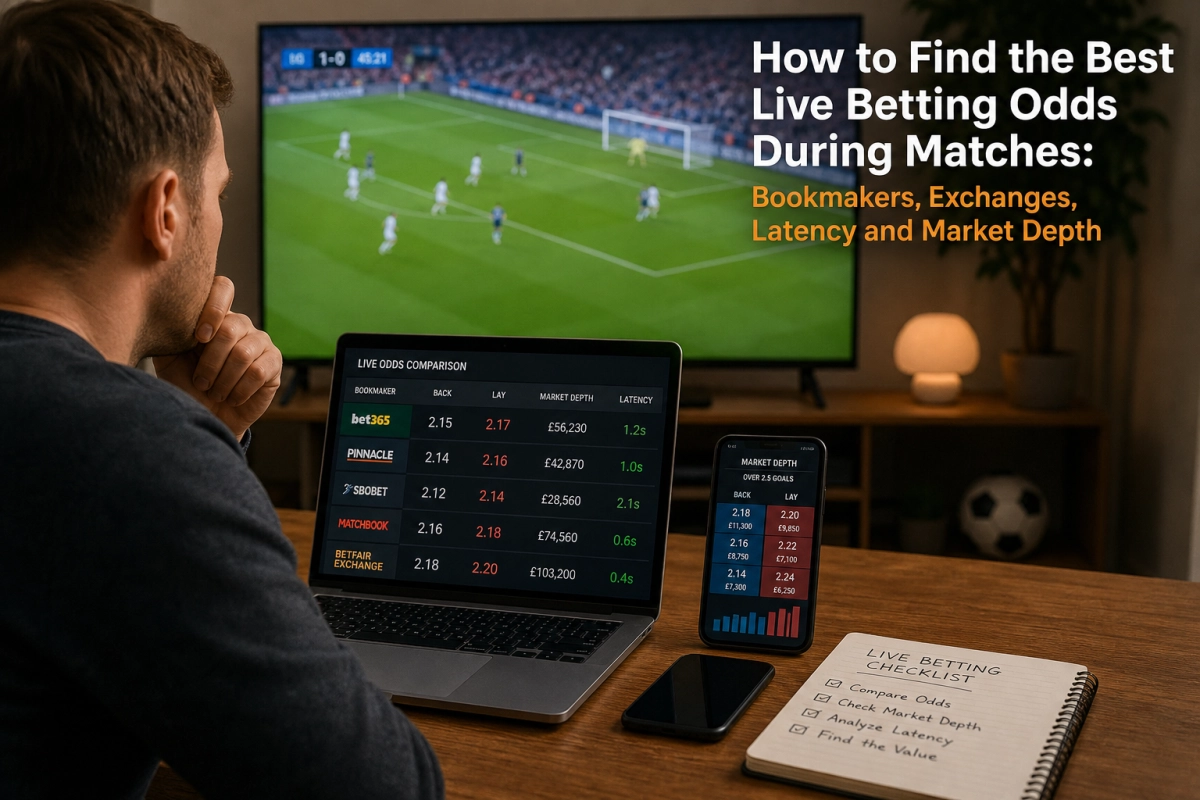
Not all platforms are equal for live betting. Bookmakers provide one-sided prices and usually higher margins, while exchanges match users against each other and can offer sharper prices if depth is sufficient.
- When to prefer exchanges: For larger stakes and when market depth is visible and deep — exchanges often give closer-to-fair value prices.
- When to use bookmakers: For smaller stakes, promotions or speed — some bookmakers prioritize in-play updates and offer features like instant cash-out.
Practical checks before placing a live bet:
- Compare the same market across two or three platforms to find the best live betting odds.
- Observe order books or available volumes (on exchanges) to assess market depth.
- Monitor stream delay and how quickly displayed odds update after major events; practice with low stakes to gauge platform latency.
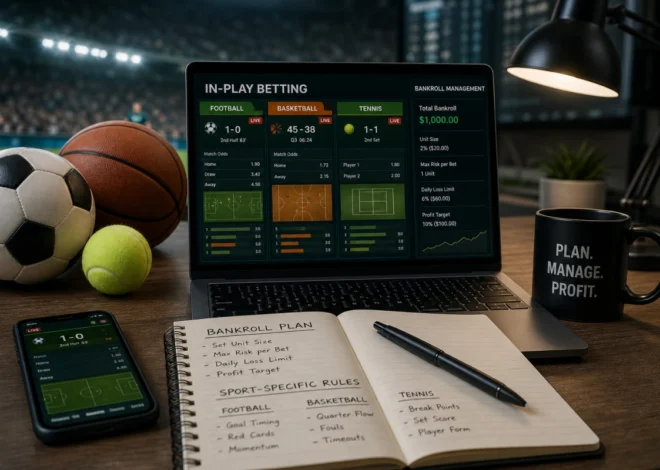
Responsible betting note: always set bankroll limits, use stake proportion rules (for example 1–2% of bankroll per live selection), and avoid chasing losses after rapid market swings.
Next, the guide will apply these comparison and latency checks to sport-specific in-play rules and decision frameworks for football, basketball and tennis so readers can act confidently during live matches.
Football: practical in-play rules and what to watch for
Football in-play markets are pace-variable — long periods of steady play punctuated by discrete events that swing probabilities. Use these sport-specific rules to act quickly but sensibly.
– Focus markets: next goal, next scorer, over/under for remaining time, correct score and Asian handicaps. Next-goal and next-corner markets are quickest-moving and most latency-sensitive.
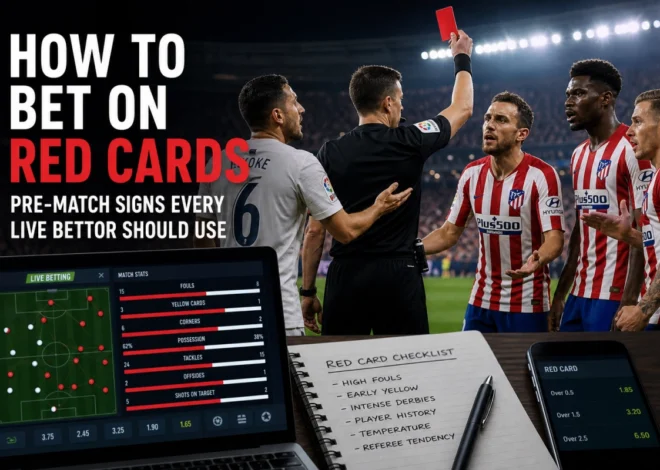
– Event triggers and signals: substitutions (especially attacking for defensive), visible fatigue, tactical changes, set-piece frequency, and referee decisions (cards, penalties) are strong predictors for immediate market moves. A red card or penalty will often reprice the match winner and over/under within seconds.
– Timing rules: late goals are more likely in matches with increased stoppage time, aggressive substitutions and teams trailing by one goal. As a rule of thumb, be wary of betting on “late winner” lines when live statistics show conservative play or significant injuries.
– Market-depth check: if the exchange shows shallow depth at shortened odds, large back bets will move the price — prefer laying or taking small stakes, or switch to a bookmaker known for speed rather than price.
– Execution examples: if Team A (underdog) presses after a 70’ attacking substitution and XG or shot rate climbs, compare next-goal prices across platforms and take the best available; if latency differs, use the faster interface even if the price is slightly worse.
– Hedging and cash-out: use exchanges to lay earlier bets if the market becomes heavily one-sided after a red card or penalty; set conditional alerts for specific events (card, substitution) to enable fast reaction.
Basketball: managing high-frequency moves and foul dynamics
Basketball is one of the fastest live markets — possessions change odds quickly and streaks create short windows of opportunity.
– Focus markets: point spread, live totals, next-score/next-player, quarter/half markets. These are highly sensitive to on-court momentum and foul situations.
– Event triggers and signals: timeouts, coaching changes, lineup rotations, foul trouble for key players, and streaks (e.g., 10–0 runs). Shot-clock situation and three-point attempts materially affect live totals and next-score lines.
– Latency and market depth: because possessions last seconds, low latency is critical for next-score and fast prop markets. Favor platforms with proven sub-second updates, and use exchanges for larger hedges where the order book shows sufficient matched volume.
– Tactical rules: when a star player picks up early fouls, expect spread and totals to drift. If a timeout follows a defensive breakdown, anticipate a likely coaching adjustment and a temporary stalling of scoring momentum — act only after confirming updated live stats.
– Staking and quick cash management: use smaller, more frequent stakes (micro-units) and predefine scalp exit points; accept that some trades will require immediate lay-off or cash-out to lock profits during volatile runs.
Tennis: point-by-point liquidity, serve hold probability and momentum
Tennis is micro-event driven: single points can flip markets, so trade execution and venue specifics matter.
– Focus markets: next point, next game, set winner, break odds and live handicaps. Next-point and next-game are highest risk/reward and demand minimal latency.
– Event triggers and signals: serve statistics (ace %, double fault), return hold patterns, medical timeouts, court surface and visible fatigue. Momentum shifts often occur after saved break points or long rallies.
– Timing and market depth: at Grand Slams and top ATP/WTA events, liquidity is generally deeper; smaller tournaments and Challenger/Futures have shallow markets — prefer bookmakers for speed or avoid next-point props there.
– Execution rules: on serve-heavy players, expect hold probability to be higher — only take aggressive back-the-break odds when the returner has shown pressure (multiple break points or weak service games). Watch for tie-break patterns: some players tighten up, creating value on set-winner prices.
– Practical hedging: use exchanges to lay earlier match bets when an opponent strings together service holds and depth allows; for next-point plays, pre-commit only if your interface confirms sub-second updates and you’ve tested execution on small stakes.
Quick live-betting checklist
- Open the same market on two or three platforms before placing a bet to spot the best price and fastest update.
- Confirm visible market depth (order book or available volumes) on exchanges when staking larger amounts.
- Test platform latency with low stakes or paper trades so you know which interface updates fastest for each sport.
- Predefine stake sizes and exit rules (cash-out or laying) for each trade; stick to 1–2% bankroll sizing for typical in-play plays.
- Watch sport-specific triggers: substitutions/penalties in football, timeouts/foul trouble in basketball, and serve/break-point patterns in tennis.
- Use micro-stakes to practice next-point/next-score markets and to verify sub-second execution capability before scaling up.
- Set alerts for key events (red cards, medical timeouts, technical changes) so you can react without constant manual monitoring.
- Keep a short post-session log of trades, execution issues, and missed opportunities to refine rules and platform choices.
Final notes on in-play betting
Live betting is an applied skill that rewards preparation, repetition and controlled risk-taking. Prioritize reliable data feeds and interfaces you can execute on comfortably, and treat early practice as part of your development rather than profit-making time.
Keep discipline central: clear staking rules, loss limits and a process for reviewing trades protect both bankroll and decision quality. If technology, speed or market depth is inconsistent for a given sport or level of competition, adapt by reducing exposure or switching markets until conditions improve.
Above all, approach in-play markets with measured curiosity — test hypotheses, record outcomes, and incrementally refine the combination of platform choice, timing rules and sport-specific reads that work best for your style and bankroll.