
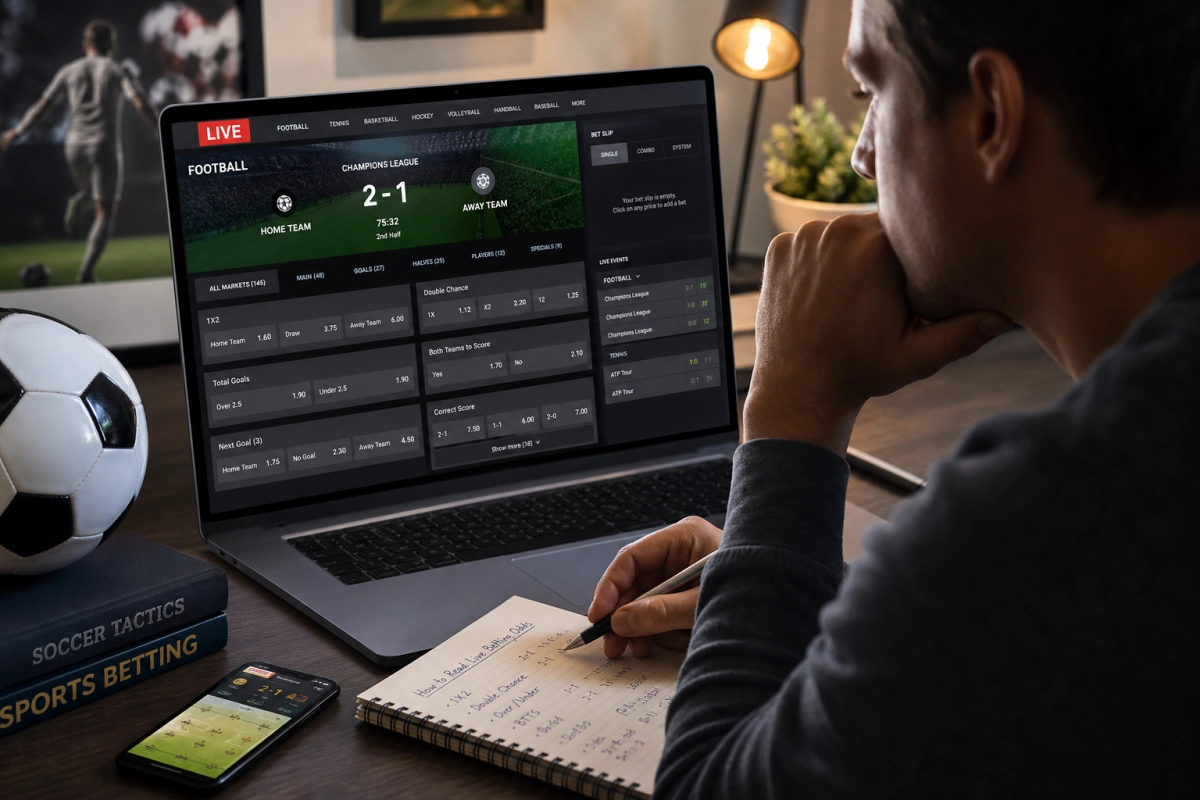
How to Read Live Betting Odds: A Practical, Sport-Specific Guide
Reading live betting odds: what moves prices during a match
Live betting odds represent a real-time market expectation while a game is in progress. This guide explains how bookmakers update in-play prices, how to read implied probability and vig, which live stats and events most reliably move odds, and simple timing and bankroll rules to make faster, more rational live bets across football, basketball and tennis.
How bookmakers adjust in-play prices and what those odds mean
Bookmakers combine models, traders and market signals to update live odds. Main drivers are model probability updates (xG, possession, serve-win chances), incoming money/liability, signals from exchanges or sharp bettors, and visible match events (goals, cards, injuries, substitutions, weather).
- Model updates: Continuous inputs (xG, shot quality, serve stats) re-price outcomes every second or minute.
- Liability balancing: Heavy bets on one side push prices down to limit exposure.
- Market signals: Sharp activity or exchange moves often force adjustments.
- Visible events: Goals, cards, injuries and substitutions rapidly change fundamentals and odds.
Understanding implied probability and the vig
Convert decimal odds to implied probability: implied probability = 1 / decimal odds (e.g., 2.50 → 40%). The sum of implied probabilities for all exclusive outcomes often exceeds 100% — that excess is the bookmaker’s margin (vig or overround) and reduces how “fair” a quoted live price is.
Key live statistics to watch and early timing rules
Successful live betting focuses on a few priority stats and timing rules to spot when the market lags reality. Use quick checks to decide if a live price offers value.
Priority live stats
- Football: final-third possession, xG per attack, shots on target, corners, substitutions, cards.
- Basketball: scoring runs, offensive efficiency, rebound differential, foul trouble, rotation after timeouts.
- Tennis: serve-hold %, first-serve points won, break-point conversion, fatigue signs.
Quick live-bet timing checklist
- Is the triggering event fresh (1–3 minutes)?
- Do live stats support a sustained probability change (not a one-off)?
- Has the market overreacted (odds moved faster than data warrants)?
- Is stake within pre-set % of bankroll and is there time for the outcome to materialise?
Sport-specific step-by-step decision rules (football, basketball, tennis)
Football: late-game value hunting
- Trigger: clear event—red card, defensive sub, or sustained attacking pressure (xG momentum over 10–15 minutes).
- Check stats: final-third possession, shots on target last 10–15 minutes, corner history, xG timeline.
- Market compare: convert odds to implied probability, estimate your fair probability (adjust pre-match model by in-play xG). Seek ≥5% edge before betting.
- Timing & stake: avoid chasing rapid moves (>10% shift in 60s). Base live stake 1–2% of bankroll; up to 3% if multiple independent signals align.
Example: 0–0 at 75′, away xG last 15′ = 0.22, book away odds 3.40 (29.4%). If your fair prob ≈36% (edge ~6.6%), consider ~1.5% stake.
Basketball: reacting to runs and rotation changes
- Trigger: identify runs (e.g., 10–0) or starter foul trouble/benching that lowers offensive efficiency.
- Check stats: last possessions’ FG%, rebound differential, and timeout/rotation confirmations.
- Market compare: estimate on-court plus/minus (starter loss ≈ −4 to −8 per 100 possessions). Require ≥5% edge for larger stakes.
- Timing & stake: prefer betting after a timeout when rotations are clear. Base 1–2% stake; up to 3% with confirmed rotation info and strict per-quarter stop-loss.
Tennis: set-by-set precision and momentum
- Trigger: break-point swings, visible fatigue, or a long game that lowers serve-hold chances.
- Check stats: first-serve % trend, second-serve points won, return points won, recent game length.
- Market compare: translate serve-hold shifts into set-win probability. If opponent’s first-serve drops significantly, upgrade returner’s chance by ~8–12% vs market.
- Timing & stake: enter between games to avoid micro-fluctuations. Base 1% stake; 1.5–2.5% when multiple indicators align.
Cash-out considerations, stake sizing and practical bankroll controls
Cash-out is a tool to lock profit or limit damage when your assessment changes, not a default tactic to chase losses. Use rules to avoid emotional decisions.
- Lock profit: accept cash-out when it guarantees original stake + 50% of expected remaining EV (convert part of uncertain EV into guaranteed gain).
- Limit loss: accept a cash-out loss only if continuing exposes you to a projected downside greater than a preset threshold (e.g., continuing risk >2× current cash-out gap).
Bankroll rules:
- Absolute live bet cap: 3% of bankroll; standard live bet 1–2%.
- Per-match exposure: combined open positions on same match ≤ 5% of bankroll.
- Daily drawdown: stop live betting for the day after losing 6–8% of bankroll.
- Recordkeeping: log each live bet (trigger, stake, odds, edge estimate, outcome) and review weekly.
Realistic live-match scenarios and quick decision workflows
Football vignette — late equalizer hunt
- Situation: 0–0 at 78′, away xG last 15′ = 0.20, three corners, home makes a defensive sub. Book away odds 3.40 (29.4%).
- Checks: confirm xG momentum (≥0.10 advantage), shots on target, and recent market moves.
- Decision: if fair prob ≈36% → edge ~6.6%, place ~1.5% stake; set a stop/cash-out plan if adverse event occurs.
Basketball vignette — starter in foul trouble
- Situation: starter gets a 3rd foul and team goes on 10–2 run. Opponent’s odds shorten slightly.
- Checks: last possessions FG%, rebound differential, timeout/rotation confirmation.
- Decision: if estimated impact translates to ≥5% win-prob edge, stake 1–2%; up to 3% if rotation confirms extended benching, with per-quarter stop-loss.
Tennis vignette — fatigue after marathon set
- Situation: Player A wins a 72-minute first set; Player B’s first-serve % drops from 66% to 52% and unforced errors rise.
- Checks: verify serve speed/drop, unforced errors, medical signs.
- Decision: upgrade returner’s next-set win probability by ~8–12% vs market; stake 1.5–2% between games.
Pre-bet timing checklist (one-minute audit)
- Is the triggering event fresh and verifiable (≤3 minutes)?
- Do live stats support a sustained probability change rather than a blip?
- Has the market already reflected the event (avoid betting if odds moved >10% in last minute)?
- Is the stake within your pre-set % of bankroll and per-match limits?
- Is there an exit plan (cash-out threshold or stop-loss) if the match reverses?
Cash-out quick rules and numeric examples
- Lock profit rule: accept cash-out when it guarantees stake + 50% of remaining EV. Example: stake $100, remaining EV $40 → lock profit if cash-out > $120.
- Limit loss rule: cash-out only if continuing carries projected downside > 2× the current cash-out gap.
- Use cash-out sparingly; default to following your original edge unless new verifiable information invalidates it.
Bankroll cheat-sheet
- Standard live stake: 1–2% of bankroll. Absolute live cap: 3%.
- Per-match open exposure cap: 5% of bankroll.
- Daily drawdown stop: halt live activity after losing 6–8% in a day.
- Record every live trade: trigger, time, odds, stake, estimated edge, result — review weekly and refine thresholds.
Putting the approach into practice
Live betting rewards disciplined repetition. Start small, trade events with rules not emotions, prioritise verifiable signals over gut reactions, protect capital with pre-set stakes and stop rules, and iteratively refine your fair-probability estimates from recorded outcomes. Over time, structured checks and strict bankroll controls separate one-off luck from a repeatable edge.