
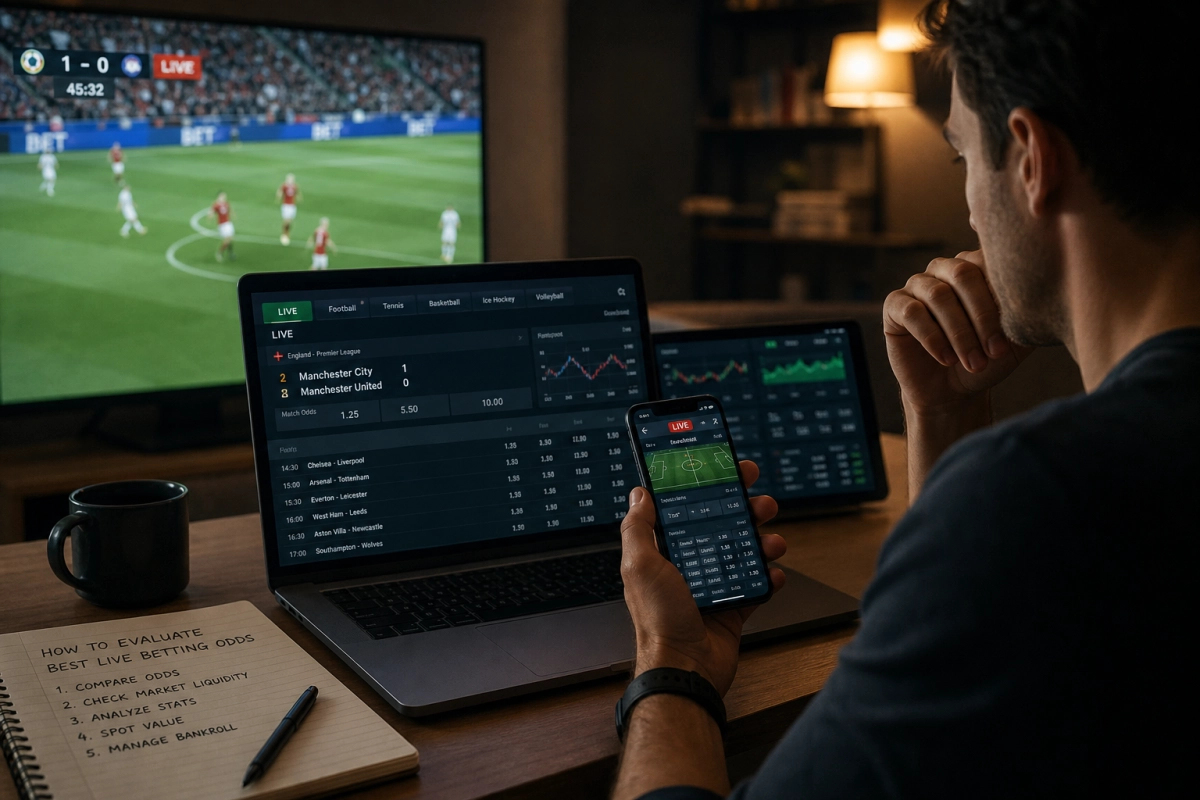
How to Evaluate the Best Live Betting Odds Across In-Play Markets
How to Evaluate the Best Live Betting Odds During a Match
Why Live Odds Need More Than a Quick Price Comparison
Finding the best live betting odds is not simply a matter of choosing the largest number displayed by a sportsbook. In-play odds change constantly as the score, time remaining, possession, injuries and match momentum develop. A higher price may reflect a less competitive market, limited liquidity or information that has not yet been fully assessed.
Live odds are the prices offered while an event is taking place. They are recalculated after important incidents, such as a goal, red card, injury, substitution, scoring run or service break. Markets may also be suspended briefly while operators confirm an event and update their risk models.
A practical comparison should consider four factors:
- Implied probability: what the odds suggest is the chance of an outcome.
- Bookmaker margin: the built-in percentage added to a market’s prices.
- Liquidity and limits: how much money can be placed without significant price movement.
- Match evidence: whether the live action supports or challenges the market’s current assessment.
Decimal odds can be converted into implied probability with the formula 1 divided by decimal odds. For example, odds of 2.50 imply 40%. However, the probabilities for all outcomes usually add up to more than 100%. This difference is the bookmaker’s overround, or margin. Comparing prices is more meaningful after allowing for that margin rather than treating every quoted probability as fair.
Comparing the Main In-Play Betting Markets
Match result and handicaps
The match-result market, often called 1X2 in football, covers a home win, draw or away win. It is easy to understand but can carry a relatively wide margin, particularly in fast-moving matches. A handicap market adjusts the starting position, giving one team a virtual advantage or disadvantage. Asian handicaps may offer more competitive pricing, but settlement rules need to be understood before a wager is considered.
Totals and next goal
Totals markets focus on whether the combined score will be over or under a specified line. The live total should be assessed alongside game speed, shot quality, tactical risk and the time remaining—not merely the current score. In basketball, possessions, fouls, timeouts and player rotations can be more informative than a short scoring burst.
The next-goal market is highly sensitive to pressure, substitutions, defensive errors and attacking territory. A team dominating possession may still create few clear chances, while a counter-attacking side can remain dangerous with less of the ball. Short prices should therefore be tested against the quality of opportunities rather than momentum alone.
Player-related markets
Player props may cover goals, points, shots, assists, cards or other statistics. These markets require confirmation that the player is still active, has an appropriate role and is not being restricted by fatigue, fouls or a tactical change. Lower liquidity can also make a displayed price less reliable and cause a stake to move the odds quickly.
The next stage is to combine these market differences with the developing match situation, price movement and practical checks before deciding whether any in-play opportunity should be ignored or investigated further.
Reading Price Movement Without Chasing the Market
Price movement can provide useful information, but it should not be treated as proof that one outcome is about to occur. A sharp shortening of odds may follow a goal, penalty, red card or injury, while a slower move may reflect sustained pressure, professional trading activity or a stream of bets from customers. The first question is whether the change is justified by a material event or simply reflects a temporary imbalance in available money.
When several bookmakers move in the same direction, the adjustment is more likely to reflect shared information or a widely observed change in match conditions. If only one operator displays a noticeably different price, it may be offering a genuine outlier, working with lower liquidity or updating more slowly. However, an apparent outlier should be checked for different settlement rules, a different line or a market that has not yet been fully suspended after an incident.
Timing is equally important. Immediately after a major event, markets can be suspended and reopened with wide spreads or rapidly changing prices. Waiting for the market to stabilise may provide a clearer comparison, although the original price may no longer be available. Conversely, delaying too long can remove any potential value if the new information has already been incorporated across the market.
Using Match Context to Test the Quoted Price
The live score is only one part of the evidence. A team leading by one goal may be defending comfortably, or it may be under constant pressure and relying on emergency clearances. Similarly, a goalless match can feature little attacking threat or repeated high-quality chances that have not yet been converted. The relevant question is whether the current performance supports the probability implied by the odds.
For totals, assess the number and quality of chances, pace of possession changes, tactical intent and likely game state. A trailing team may introduce another attacker, creating more opportunities but also leaving space for counters. In basketball, a team’s foul situation and rotation depth can materially affect the final minutes. In tennis, serving performance, physical movement and the score within the current game may matter more than the overall set score.
For handicaps and match-result markets, consider whether the leading side is protecting its advantage or continuing to attack. A red card, key substitution or visible injury can alter the effective strength of each team even before the scoreboard changes. Player markets require the same contextual test: a striker’s shots line may look attractive, but it is less persuasive if the player has moved wide, is isolated by a tactical adjustment or is visibly managing a knock.
Checking Margin, Liquidity and Settlement Details
After identifying a potentially attractive price, compare the full market rather than focusing on one selection. Add the implied probabilities of all available outcomes to estimate the overround. A lower total generally indicates a more competitive market, although it does not guarantee that every individual price is superior. Comparing equivalent lines across several bookmakers can reveal whether the value is in the price, the handicap or the total itself.
Liquidity affects how practical the quoted odds are. A price available for a small stake may not remain available for a larger one, particularly in player props and next-goal markets. Check maximum stakes, spreads, partial acceptance and whether the displayed price is guaranteed or subject to confirmation. Finally, verify rules for void bets, abandoned matches, player participation, overtime and push outcomes. These details can materially change the effective value of an otherwise appealing live quote.
Making Better Decisions in Fast-Moving Markets
A disciplined live-betting process is often more valuable than reacting quickly. Before placing a wager, pause long enough to confirm the market, line, price, available stake and relevant match information. If the odds no longer reflect the situation or the market has moved beyond a reasonable level, there is no obligation to participate.
The strongest decisions come from patience, consistent comparison and clear limits. Treat every live price as a changing estimate rather than a certainty, and accept that sometimes the best choice is to wait for more information or leave the market alone.

Related Posts
A practical, in-play guide to betting on red cards: spotting live signals and choosing markets
A practical guide to pre-defining and applying dynamic stop-loss and take-profit rules for live betting bankroll management