
How to find the best live betting odds in-play: tools, latency and smart execution
How to identify the best live betting odds while a match is in play
Finding the best live betting odds in-play requires speed, context and discipline. This guide explains what live odds are, which in-play markets matter, and the tools and execution tactics that give an edge — while emphasising bankroll protection and responsible decision-making. The goal here is practical, sport-specific advice that helps readers act quickly and rationally during live action.
Understanding live odds, in-play markets and key terms
Live (in-play) odds change dynamically as a match unfolds. They reflect market perception of probability after events like goals, timeouts or injuries. Common terms to know:
- Live odds — current prices available for a market while the event is underway.
- In-play markets — markets offered during a match (match winner, next goal/point, totals, handicaps, corners, etc.).
- Cash out — a bookmaker option to settle a bet early for a reduced or increased amount based on current odds.
- Match momentum — the current flow of play that changes probabilities (scoring runs, pressure, possession).
- Handicap — a line that evens out teams by giving a virtual advantage/disadvantage.
- Totals (Over/Under) — predicted combined points/goals; useful for live adjustments when attack/defence balance shifts.
- Next goal / Next point — short-term markets that react immediately to momentum swings.
Example: In football, a team dominating possession in the final 15 minutes after a red card may see its win probability and associated odds shorten quickly; recognizing that momentum early helps capture better prices before the market fully adjusts.
Essential tools for finding the best live odds and why latency matters
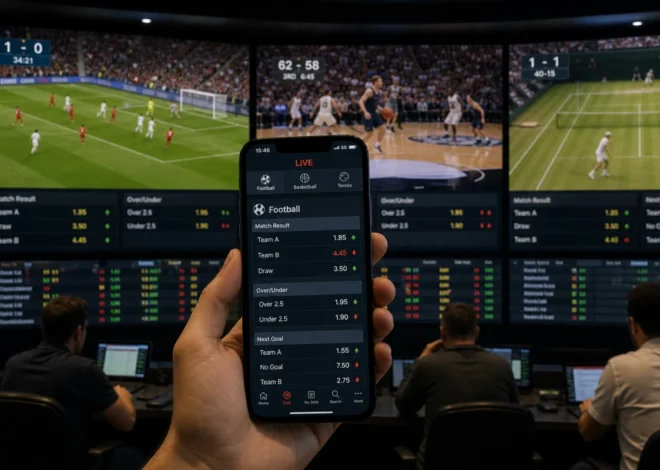
Using the right combination of apps, odds feeds and exchange access reduces execution friction. Key tools:
- Bookmaker mobile/web apps with fast in-play interfaces for quick bets and cash out.
- Betting exchanges (e.g., peer-to-peer marketplaces) that often offer tighter spreads and back/lay flexibility.
- Real-time odds feeds and price comparison tools to spot best live pricing across multiple firms.
- Live statistcs widgets (possession, shots, serve speed, break points) that show underlying momentum.
Latency — the delay between an event on the pitch and the reflected odds or stats — is critical. Even a few seconds of lag can move prices against you. Reduce latency by:
- Using native mobile apps over web versions when possible.
- Choosing bookmakers with proven fast in-play markets or direct API feeds.
- Keeping a single focused workspace: one odds-comparison screen plus one execution window.
Execution tactics: pre-decide stake sizes, keep bets simple (back or lay, not complicated multi-leg in-play), and use exchange laying to hedge quickly when markets flip.
With these basics and tools set up, the next sections will explore which live markets to prioritise and practical tactics tailored to football, basketball and tennis action.
Which live markets to prioritise for football, basketball and tennis
Focus your in-play attention on markets that move predictably with observable momentum and where you can act faster than the market adjusts. Below are sport-specific priorities and why they offer value.
Football
– Next goal / next team to score: reacts immediately to possession, pressure and red cards. Short-term probability swings are large — getting in early when a team piles forward (after a substitution or late push) can yield value.
– Asian handicaps and 0.5/1.5 totals: these absorb single-event noise better than match-winner prices and are useful when domination doesn’t translate to a goal yet.
– Over/Under 2.5 and 1.5 live lines: useful around set-pieces and after cards. If a match opens up (more shots/headers), over prices tend to shorten quickly — capturing value requires speed.
– Corners and bookings: lower liquidity but more correlated to tactical changes (e.g., a team protecting a lead). Use these when statistical feeds show an uptick in attacking metrics.
Basketball
– Game spread and quarter markets: basketball is possession-dense and the spread frequently drifts with scoring runs. Quarter markets often present the quickest opportunities because momentum swings are contained and easier to read.
– Live totals (over/under) with shot clock awareness: teams that play fast or draw fouls alter scoring pace quickly — monitor pace metrics.
– Player props (points/rebounds/assists) late in games: rotation patterns and foul trouble give visible cues; smaller liquidity means bigger edges if you know lineups.
Tennis
– Next point / next game: tennis is ideal for micro-betting because each point changes probability and stats (serve speed, first-serve percentage) are immediate.
– Break point / hold probabilities: serveers under pressure often have predictable drops in hold probability; use this against inflated pre-match odds that didn’t account for in-match form.
– Set winner when momentum flips: a tie-break or decisive service weakness can swing set markets fast — act before server-change adjustments are fully priced.
Sport-specific execution and timing tactics
Execution differs by sport due to pace and liquidity. Practical tactics:
– Pre-define triggers: for football, a dominant 10-minute spell with multiple shots on target; for basketball, a scoring run of 10+ unanswered points; for tennis, a player serving at <55% first-serve in a critical game. Only bet when your trigger conditions are met.
– Use laddering: split stakes across two consecutive prices (e.g., half at current price, half slightly worse) to average execution without missing the move entirely.
– Hedging on exchanges: when a position flips (e.g., you backed a team and they fall behind), lay the new favourite on an exchange to lock profit or cut loss.
– Exploit micro-mismatches: bookmakers sometimes delay updating niche markets (corners, player props). Monitor these and act while the main markets correct.
Account, stake and bankroll management to protect in-play capital
In-play volatility requires stricter risk controls than pre-match betting.
– Use a dedicated live bankroll: keep a smaller, separate pool for in-play bets (e.g., 20–30% of your total bankroll) to prevent impulsive depletion of long-term funds.
– Flat-percentage staking with caps: size stakes at a fixed small percentage (1–2%) of the live bankroll, with a maximum absolute stake per event.
– Kelly-lite for edge sizing: if you quantify an edge, use a fractional Kelly (10–30%) to avoid ruin from variance.
– Limit simultaneous exposure: set a cap on concurrent active bets (2–3) to avoid correlation risk across markets in the same match.
– Pre-set stop-loss and profit targets: define daily and per-event loss limits and lock-in rules (e.g., stop after -5% of live bankroll or take profits at +10%).
– Maintain discipline with heat checks: if you’ve made several losing in-play bets, pause and reassess rather than increasing stakes to chase losses.
These sport-specific market choices, execution rules and strict bankroll controls will keep you in the game long enough to exploit recurring in-play edges rather than being wiped out by short-term volatility.
Live-betting session routine
- Pre-match prep: fund your live bankroll, update apps, check connectivity and latency on your primary execution window.
- Define session rules: maximum number of active bets, stake size cap, daily loss/profit limits and triggers you’ll act on.
- Start with a dry run or small stakes for any new market or tactic to confirm execution speed and price behavior.
- Execute only when your predefined triggers are met; use laddering or partial fills rather than all-or-nothing entries.
- Record every bet immediately: market, stake, odds, trigger, outcome and a one-line rationale to enable later review.
- End-of-session review: check whether rules were followed, identify missed opportunities, and note any tech or latency issues to fix.
- Pause when fatigued or emotionally agitated — protecting capital means stopping as often as it means acting fast.
Staying disciplined and iterating your edge
Successful live betting is a process of continual refinement, not a collection of one-off wins. Keep meticulous records, run small, controlled experiments when testing new markets or execution tactics, and treat each session as data to improve decision-making rather than as a source of validation. Technology and market behaviour change, so maintain your tools, monitor latency, and be ready to adapt strategies that no longer produce an edge.
Above all, prioritise discipline: predefined rules, fixed staking plans and enforced stop-losses protect your longevity. If you maintain a methodical approach — test before scaling, log everything, and step away when emotion creeps in — you’ll preserve the optionality to exploit genuine in-play value when it appears.
Common live-betting mistakes and how to avoid them
Even experienced bettors fall into predictable traps during in-play sessions. Recognising and systematically eliminating these mistakes protects capital and preserves long-term edge.
- Chasing losses — increasing stakes after a string of losses is the fastest route to ruin. Fix: enforce a hard stop-loss for the session and a mandatory pause after breaching it; review decisions before resuming.
- Overtrading — taking too many small, low-value bets because action feels satisfying. Fix: restrict the number of active trades per match and require a documented trigger for every entry.
- Ignoring liquidity and market impact — placing large bets into thin markets moves prices against you. Fix: size stakes relative to market depth, use exchanges for large positions, and ladder orders to reduce impact.
- Acting on delayed information — streaming lag, slow stat widgets or mobile notifications can make you habitually late. Fix: measure your end-to-end latency, prioritise low-lag providers, and never bet solely on a delayed visual feed.
- Neglecting confirmations (lineups, injuries, weather) — last-minute changes often swing probabilities dramatically. Fix: verify starting lineups and injury reports from reliable feeds before increasing exposure; suspend betting for 1–2 minutes after any official announcement.
- Poor recordkeeping and confirmation bias — without objective records you reinforce false beliefs. Fix: log every bet with a short rationale, then review monthly to identify reproducible edges versus lucky streaks.
Addressing these common errors reduces variance and preserves the discretionary margin needed to exploit genuine live value when it appears.
Advanced tips: automation, APIs and professional workflows
Serious in-play operators combine human judgement with automation to gain milliseconds and scale disciplined rules. Automation doesn’t replace edge selection — it executes it more consistently.
- Use APIs for price and execution — where permitted, connect to bookmaker and exchange APIs to stream prices and place orders programmatically. This reduces manual delays and supports complex hedging logic.
- Build simple automation rules — start with scripts that watch a defined trigger (e.g., “team X has 3+ shots in 10 minutes and odds shorten by 20%”) and send alerts or execute pre-approved stakes. Keep kill-switches and manual overrides.
- Leverage VPS and geo-optimised routing — host execution scripts close to bookmaker servers to lower latency, and use a reliable VPS provider rather than local home connections for mission-critical automation.
- Monitor order book depth on exchanges — the available back/lay size at each price level reveals true liquidity; avoid markets where depth is shallow relative to your stake.
- Use multi-account workflows responsibly — distributing bets across accounts or bookmakers can reduce single-account limits and execution friction, but track each account’s P&L and exposure precisely.
Checklist before you place an in-play bet
- Have my predefined trigger been met exactly?
- Is my stake size within the live-bankroll percentage and single-event cap?
- Is market liquidity sufficient for my stake?
- Have I checked lineup/injury/official announcements in the last 2 minutes?
- Is latency acceptable on my execution window right now?
- Do I have a clear hedge/exit plan if the market flips?
- Have I logged the bet rationale and expected edge?
Following that checklist and combining the behavioural, technological and bankroll controls above will materially increase the probability that your in-play activity is profitable and sustainable rather than reactive and destructive.