Practical In-Play Betting Bankroll Management: Sport-Specific Rules for Football, Basketball & Tennis
Live betting fundamentals: what “in-play betting” means and why rules matter
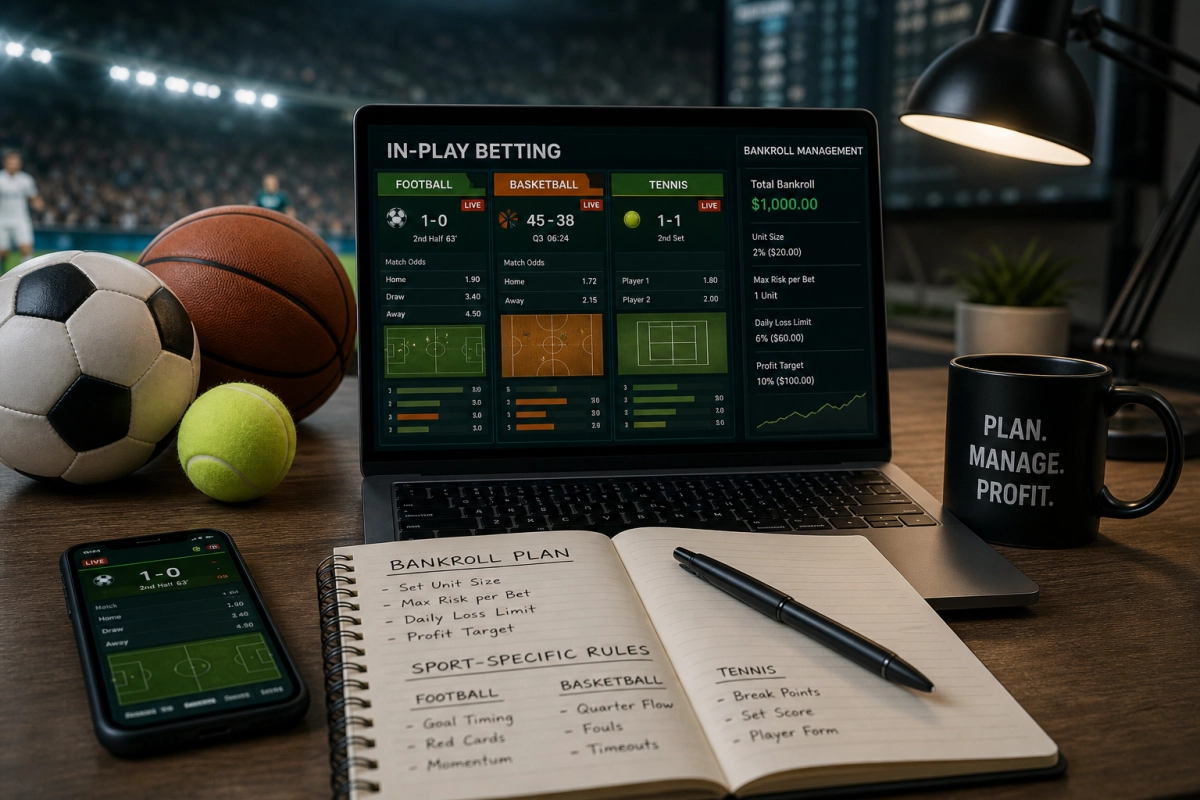
In-play betting — staking after a match starts — is fast and reactive. Live odds, in-play markets and momentum swings respond to goals, runs, injuries and tactical changes. That creates opportunity and volatility. A clear bankroll plan and simple session rules keep decisions rational and repeatable, and prevent emotion-driven mistakes.
Core live betting terms explained
- Live odds: The current price during an event; they update in real time.
- In-play markets: Match-winner, next goal/point, totals, handicaps, corners, etc., available while the event runs.
- Cash out: Option to settle a bet early, usually at reduced value.
- Match momentum: Short-term control or pressure that changes near-future probabilities.
- Handicap and totals: Lines adjusted during the event to trade imbalances as the match evolves.
- Live statistics: Real-time data (xG, possession, shots, serve speed, unforced errors) used to check if odds reflect reality.
Why bankroll rules must be different for football, basketball and tennis
Speed and scoring patterns determine live risk. Football’s low scoring and long pauses make single events (a goal, red card) decisive; basketball’s many possessions and rapid scoring create frequent short-term edges; tennis flips momentum point-by-point. A single staking plan across all sports increases exposure and mistakes.
Practical differences and quick examples
- Football: One goal late can swing odds dramatically — prefer smaller stakes on next-goal markets and respect time decay.
- Basketball: Short run streaks produce transient edges — stakes can be larger for quick plays but controlled with short stop-losses.
- Tennis: Serve holds, break points and fatigue flip momentum rapidly — size smaller on single-point markets and widen caution around pivotal games.
Basic staking frameworks suitable for live markets
- Flat-percent: Fixed small percentage per live opportunity (e.g., 0.5–2% of bankroll).
- Session budgeting: Pre-define a session allocation and max trades to prevent escalation.
- Volatility adjustment: Reduce stakes when uncertainty is high (red card, injury, weather).
Sport-specific stake-sizing templates (ready-to-use)
Football
- Conservative: Session = 2% BK; Next-goal = 0.25% BK; Match swings pre-70′ = 0.5% BK; Max trades = 6; Per-match cap = 1.5% BK.
- Standard: Session = 4% BK; Next-goal = 0.5% BK; Match-result pre-70′ = 1% BK, reduce after 80′; Max trades = 8; Per-match cap = 1.5% BK.
- Aggressive: Session = 6–8% BK; Next-goal = 1% BK; Match-result pre-70′ = 2% BK; Max trades = 10; Per-match cap = 3% BK.
Basketball
- Conservative: Session = 3% BK; Quick-play = 0.25% BK; Quarter trades = 0.5% BK; Max trades = 10; Per-game cap = 2.5% BK.
- Standard: Session = 6% BK; Quick-play = 0.5% BK; Quarter trades = 1% BK; Max trades = 15; Per-game cap = 2.5% BK.
- Aggressive: Session = 8–10% BK; Quick-play = 1% BK; Quarter trades = 1.5–2% BK; Max trades = 20; Per-game cap = 4% BK.
Tennis
- Conservative: Session = 3% BK; Game/serve = 0.5% BK; Point markets = 0.25% BK; Max trades = 8; Per-match cap = 2.5% BK.
- Standard: Session = 5% BK; Game/serve = 0.75–1% BK; Point markets = 0.5% BK; Max trades = 12; Per-match cap = 2.5% BK.
- Aggressive: Session = 7–9% BK; Game/serve = 1–1.5% BK; Point markets = 0.5–1% BK; Max trades = 15; Per-match cap = 4% BK.
Tip: If you quantify an edge, consider fractional Kelly sizing (e.g., 0.25 Kelly) only after you can estimate probabilities reliably.
Session rules: entry limits, stop-losses and trade caps
- Pre-session check: Confirm bankroll, session budget, max trades and time-block. If market volatility is elevated, cut session budget by 50%.
- Max consecutive loss: Stop trading for 30–60 minutes after three losses in a row or a session loss exceeding a preset percent (e.g., 2% BK).
- Max consecutive win: Reduce stakes by ~25% after multiple wins to avoid overconfidence and bookmaker limits.
- Time-decay: In football lower stakes after 75′; in tennis be cautious late in decisive sets; in basketball avoid new large exposure in the final quarter unless hedged.
- Trade cap per match: Never exceed the per-match exposure cap in your template; avoid chasing.
Sport-specific stop-losses
- Football: Single-event stop-loss = 1.5–3% BK by template. Do not double down after late goals.
- Basketball: Short stop-loss per run; close correlated positions if a trade loses a defined portion (e.g., 50%).
- Tennis: Use point-based exits — if a player loses consecutive break points and your stake is underwater, step back before adding.
Emergency controls and recovery protocols
- Immediate triggers: Major injury/red card, abandonment, bookmaker glitch, sudden weather stoppage, or account restriction.
- Actions: Pause new bets for 15–60 minutes; reduce live stakes to ~25% for the next two trades; isolate and close correlated positions where feasible; log the incident.
- Recovery: Review events and re-calc probabilities with live stats before resuming; begin with two half-sized trades to test stability; if losses exceed session stop-loss end the day and review.
Session checklists and quick-print stake tables
Football — session checklist
- Confirm bankroll, session budget, max trades and per-match cap; check team news and tempo.
- Enter next-goal or match trades only when live stats and momentum support the stake per template.
- Apply time-decay after 75′; halve stakes after major incidents (red card/injury).
- Enforce stop-losses and log every trade (time, market, stake, odds, result, rationale).
Basketball — session checklist
- Set time-block, session budget and max trades; identify pace or rotation edges pre-game.
- Use quick-play entries for possessions/quarters; increase only after confirmed momentum shifts.
- Apply short run stop-losses and avoid excessive final-quarter exposure unless hedged.
- Post-session: review lineups/timeouts that created the edge and update your watchlist.
Tennis — session checklist
- Select matches with clear serve patterns or fatigue signals; set session budget and max matches.
- Prefer game/serve markets where value is supported by form or stats; use smaller stakes on single-point markets.
- Tighten stakes around pivotal games/tiebreaks; use point-based exits when chances cascade against you.
- Post-session: tag matches for fitness or surface effects and log decision quality for refinement.
Short case studies: applying rules in real time
Football — late goal reversal (80′, home 1–0)
- Situation: Home up 1–0 at 80′; away pressing and next-goal odds shorten.
- Action: Use conservative/standard template — 0.25–0.5% BK on away next-goal only if live xG and shots support it; avoid large match-result bets.
- Emergency: If a red card occurs pause and cut the next two stakes to 25% until stability returns.
Basketball — mid-game momentum run (2nd quarter, 10–0 run)
- Situation: Team A on a 10–0 run after timeout and quarter handicap lags.
- Action: Enter per template (0.5–1% BK), set a short stop-loss (e.g., close at 50% loss of planned stake) if reversal appears.
- Emergency: If starters are subbed and run halts, close correlated positions and reduce stakes for the next two trades.
Tennis — late-match fatigue and service breaks (3rd set)
- Situation: Player B shows reduced serve speed and longer points; odds for opponent to break shorten.
- Action: Place a standard game/serve trade (0.75–1% BK) when live stats confirm more return winners and unforced errors.
- Emergency: If B holds twice in a row, consider cashing out or closing; do not scale up after a losing sequence.
Closing principles for disciplined live staking
In-play betting rewards discipline more than bravado. The real edge comes from consistent rules, conservative sizing, and honest recordkeeping — not from chasing big wins. Treat each session as an experiment: test templates, log outcomes, and refine rules based on evidence. When emotion or noise appears, the session rules and emergency controls are the tools that keep your bankroll intact. Start with the conservative templates, use the checklists, and iterate patiently. Over time the small, disciplined improvements compound; that is the strategic advantage in live markets.