

Value Betting Tips for Consistent Long-Term Profits
Move from guessing to systematic value betting
You can’t rely on intuition alone if you want steady returns from sports betting. Value betting is a discipline: it focuses on spotting odds that are higher than the true probability of an outcome and staking in proportion to that edge. When you consistently place bets where the market underestimates the chance of an event, the law of large numbers works in your favor. This first part explains the mindset and early practices you need to build a repeatable value-betting approach.
Why value betting is the foundation of long-term profit
Value betting differs from prediction-based or tip-driven approaches because it treats odds as price signals, not guarantees. If you can estimate the true probability more accurately than the market or odds providers, you’ll find positive expected value (+EV) bets. Over many bets, a positive average expectation translates into profit even when individual bets lose. To get there, you must learn to:
- Think in terms of probabilities rather than certainties.
- Quantify edges using simple math (expected value and implied probability).
- Treat variance as an expected part of the process, not a failure.
Practical early steps: calculate value and test your edge
Before increasing stakes, verify that your selections actually offer value. You’ll use two basic calculations: converting odds into implied probability and comparing that to your own probability estimate.
Quick method to spot value
Follow these steps for every candidate bet:
- Convert bookmaker odds into implied probability (for decimal odds, implied probability = 1 / odds).
- Estimate the true probability of the outcome using data, form, matchup analysis, and public-market tendencies.
- Calculate expected value: EV = (your probability × bookmaker odds) − 1. If EV > 0, the bet is theoretically +EV.
Keep your early testing small and track every wager. Use a simple spreadsheet with columns for date, market, odds, implied probability, your probability, EV, stake, and result. Over hundreds of bets you’ll see whether your model or judgment actually beats the market.
Basic data sources and tools to improve your estimates
Improve your probability estimates by using objective inputs: historical match data, head-to-head records, injury reports, weather, and market movement. Free tools like odds converters, basic statistical databases, and bookmaker odds history can quickly boost accuracy. Also, pay attention to where public money concentrates—sometimes favorite-heavy markets are overvalued by bookies to balance liability, creating opportunities for you.
With these foundations in place—probabilistic thinking, simple EV math, and routine tracking—you’ll be ready to refine staking strategy and market scanning techniques in the next section.
Smart staking: protect your bankroll and scale with confidence
Once you can identify +EV opportunities, the next discipline is staking: how much to wager when you have an edge. Staking is where sound math meets psychology. Bet too large and one bad run can destroy both capital and confidence; bet too small and even a proven edge won’t produce meaningful returns. Use a systematic staking rule tied to your measured edge and bankroll.
Two practical approaches work well for value bettors:
- Fractional Kelly: The Kelly formula tells you the optimal fraction of your bankroll to wager given an edge, but full Kelly is volatile and sensitive to estimation error. Use fractional Kelly (typically 20–50% of full Kelly) to capture growth while reducing drawdowns. A quick reminder: for decimal odds b = odds − 1, your Kelly fraction f* ≈ (b·p − (1 − p)) / b, where p is your estimated probability. Scale that down—say, to 25%—and you have a practical stake size.
- Fixed-percentage units: If Kelly math feels too granular, adopt a simple unit system: define a unit as 1–2% of your bankroll and size bets by how many units the stake equals based on your confidence/EV band. For example: small edge = 0.5 units, moderate = 1 unit, strong = 2–3 units.
Follow these operational rules:
- Recalculate unit size after any 20–30% change in bankroll; avoid “topping up” mid-run to chase losses.
- Cap maximum single-bet exposure (e.g., no more than 5% of bankroll) to protect against model error and bookmaker limits.
- Never use progressions (martingale) to recover losses; they amplify variance and risk ruin.
- Track not just wins/losses but variance metrics: return on investment (ROI), yield, and standard deviation to understand your long-term performance.
Advanced market scanning: where consistent value hides
Finding value is as much about where and when you look as it is about how you calculate probabilities. The bookmakers are efficient in high-liquidity markets—top leagues and popular matchups—so hunt in areas where their models are weaker or where public biases distort prices.
Effective scanning tactics:
- Line shopping: Maintain accounts with multiple bookmakers and use odds-comparison tools. Small price differences compound over many bets; always take the best available odds for a given selection.
- Early and late lines: Early market inefficiencies can exist before books adjust, but late movement often reveals sharp action. Monitor opening lines and subsequent shifts—if your model disagrees with the direction of sharp money, there may be value or a warning sign.
- Niche markets and lower leagues: These markets are less efficient due to limited data and lower liquidity. Use domain-specific knowledge (local reports, rotation patterns, travel schedules) to gain an edge.
- In-play opportunities: Live betting presents frequent mispricings as books react to fast-developing events. Automate alerts for specific triggers (red cards, injuries, momentum swings) and size stakes conservatively since odds move quickly.
- Use tools and automation: APIs, odds feed aggregators, and value-alert services can scan dozens of markets per second. Build simple filters—min EV threshold, minimum odds difference, league filters—to reduce noise and focus on true opportunities.
Finally, monitor closing line value (CLV) as a performance metric: consistently beating the closing market over many bets indicates genuine edge, even if short-term results are poor. Combine disciplined staking with targeted scanning and you’ll turn sporadic wins into a sustainable value-betting process.
Account management and data hygiene
Protecting your accounts and maintaining clean data are practical steps that preserve your ability to bet long term. Use multiple bookmakers to shop lines, keep two-factor authentication enabled, and document any account suspensions or limit changes so you can adapt your staking plan. Back up your spreadsheet or database regularly, timestamp your data imports, and standardize naming conventions for leagues and markets to avoid analysis errors.
- Spread exposure across several bookies to reduce single-account risk.
- Keep a research log noting why you placed each bet—this makes post-hoc review easier.
- Respect local laws and tax rules; track taxable events separately if required.
Sustaining your edge: mindset, routines, and next steps
Long-term success in value betting comes less from one clever model and more from disciplined routines. Commit to continuous improvement: review results regularly, stress-test your assumptions, and be ready to adapt when markets shift. Protect your psychology by accepting variance as a feature of the game—maintain bankroll rules through losing streaks, and step back when emotion clouds judgement.
- Set fixed review cycles (e.g., monthly and quarterly) to evaluate ROI, CLV, and variance metrics.
- Automate what you can: odds feeds, bet logging, and alerts reduce manual errors and free time for analysis.
- Stay humble and curious—read research, join responsible communities, and test new ideas only with small stakes first.
- If sizing confuses you, revisit the underlying math before changing behavior; a clear primer like Kelly criterion explained can help ground decisions.
Value betting is a long game. Keep your processes simple, protect your capital, and treat every bet as data that informs better decisions tomorrow. With patience, disciplined staking, and consistent review, you’ll give genuine skill the time it needs to show up in your results.

Related Posts
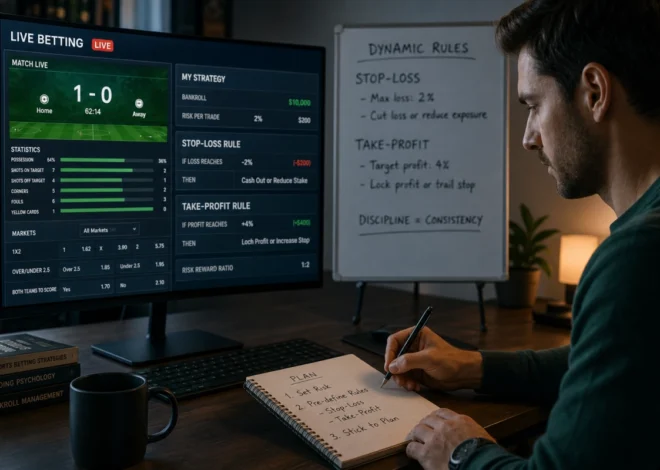
A practical guide to pre-defining and applying dynamic stop-loss and take-profit rules for live betting bankroll management

How to find the best live betting odds in-play: tools, latency and smart execution