

Odds Comparison Tips: How to Use Multiple Books Effectively
Why comparing odds across multiple books will improve your results
You probably know that different sportsbooks post different numbers for the same event. What you might not appreciate is how consistently small differences in odds and lines add up to a meaningful advantage. When you compare odds across multiple books, you reduce the house edge you pay, increase your chance of finding value bets, and sometimes discover arbitrage opportunities that guarantee profit.
How small edges turn into long-term gains
- Line shopping: Picking the best available price for every wager lowers your break-even threshold. A few percentage points saved on implied margin compound across dozens or hundreds of bets.
- Reduced vigorish: Different books charge different vig. Favoring books with lower commission effectively increases your expected return over time.
- Exploit market inefficiencies: Public money, sharp action, and timing differences create temporary mispricings. Comparing odds lets you spot those moments quickly.
Recognize the practical limits
You should also be realistic: not every discrepancy is exploitable. Books may limit or ban sharp accounts, and odds can change quickly. Some gaps reflect available betting limits or internal risk controls rather than pure mispricing. Understanding why lines differ helps you decide which opportunities to chase and which to ignore.
How to build an efficient odds-comparison routine
Setting up a reliable process is as important as the books you use. You want a workflow that’s fast, repeatable, and minimizes the chance you’ll miss a better price. Below are pragmatic steps to streamline comparing odds across multiple sportsbooks.
Choose the right mix of books and tools
- Diversify providers: Use a mix of mainstream, regional, and niche books. Large books often have tighter markets; smaller books sometimes offer softer lines or higher limits.
- Use odds-comparison sites or apps: Aggregators let you scan dozens of prices in seconds. Pair them with browser bookmarks or a simple spreadsheet for manual checks.
- Keep format consistent: Convert all odds to decimal or implied probability so you can compare apples to apples quickly.
Practical rules to follow when line shopping
- Compare odds before you place the bet — not after.
- Account for bet limits: a better line with a tiny max stake may be less useful than a slightly worse line with a full limit.
- Watch for timing: early lines and live prices behave differently — build separate strategies for each.
- Track your prices and outcomes so you can measure actual value gained from line shopping.
Now that you understand why multiple-book comparisons matter and how to set up a routine, the next section will walk you through a step-by-step workflow with concrete examples, calculations for implied probability, and checks to avoid common traps when placing your bets.
A step-by-step line-shopping workflow (with concrete calculations)
Use this sequence every time you find a bet. It’s deliberately simple so you can run it under pressure — especially useful for live markets.
- Gather prices: Pull the best odds for the same market from your top three books or an odds-aggregator.
- Convert to decimal and implied probability: Decimal odds O -> implied probability p = 1 / O. Do this for every price so you can compare directly.
- Check for value or arbitrage: Add the implied probabilities for all mutually exclusive outcomes. If the sum S < 1.00 you have a pure arbitrage. If S > 1.00, compute the book’s margin (vig) = S – 1.00; compare your own model’s probability to the market probability to spot value.
- Allocate stakes: For arbitrage, split your total stake T so the payout is identical whichever outcome wins: stake_i = T * (1/O_i) / S. For value bets, put as much as your sizing model allows on the best available price, subject to limits.
- Place the bets and document: Record the odds, stake, book, timestamp, and expected return before you hit submit.
Concrete arbitrage example: Book A offers 2.10, Book B offers 1.95 for a two-outcome market. pA = 1/2.10 = 0.47619; pB = 1/1.95 = 0.51282; S = 0.98901 (<1). For a $100 total stake, stakeA = 100*(0.47619/0.98901) ≈ $48.16; stakeB ≈ $51.84. The guaranteed payout ≈ $101.11, so profit ≈ $1.11 (≈1.11%).
How to size bets across multiple books (practical allocation rules)
When the best price has a low limit, you still want to capture as much value as possible. Use straightforward rules rather than overcomplicated formulas in the heat of action:
- Fill the best price first: Place the maximum allowed on the highest odds, then use the next-best price for remaining exposure.
- Estimate per-dollar edge: For a given market, compute per-dollar EV = p_model * O – 1 (decimal). Use this to rank offers — put more money where per-dollar EV is highest.
- Combine limits with your stake size: If you want $200 on an event and Book A has a $100 cap at superior odds, take the $100 at Book A and place the remaining $100 at the next-best book. Track the blended EV across both books.
- Use conservative Kelly or fractional sizing: If you use Kelly, calculate independently per book/outcome and scale it down (20–50% Kelly) to avoid large swings, especially when accounts might be limited.
Example: your model gives p=0.52 for Team X. Odds 2.10 give EV per dollar ≈ 0.092; odds 1.95 give EV ≈ 0.014. Prioritize the 2.10 until its limit is reached, then use 1.95 for the balance.
Common traps and a pre-bet verification checklist
A few fast checks will stop most costly mistakes. Run through them mentally or have a one-line checklist on your phone.
- Confirm odds are live and not stale (refresh aggregator or book feed).
- Check max stake and potential partial fills — a “better” line with a tiny limit can be pointless.
- Watch for correlated-leg pitfalls (parlays where legs affect each other) — implied math can be wrong.
- Read settlement rules and void/cancellation policies for the book handling the bet.
- Beware of bonuses and promo T&Cs that alter actual payout or impose rollovers.
- Confirm your bankroll and available balance on each account before submitting multiple bets.
- Flag unusual price swings — they may signal late sharp money, injury news, or simply an error.
Following this workflow and checklist keeps your process fast, repeatable, and resilient to the common operational traps that wipe out theoretical advantages. In the next part we’ll cover record-keeping, simple analytics to measure your line-shopping gains, and how to scale while avoiding limits and bans.
Record-keeping, simple analytics and scaling safely
What to record (minimum viable ledger)
- Date, event and market (e.g., NBA: Moneyline).
- Odds per book used, stake per book, and max limits encountered.
- Your model or subjective probability and the market-implied probability.
- Placement time and whether the line was live, early or closing.
- Result, net profit/loss, and realized ROI for the wager.
- Notes on why you placed the bet (value, arbitrage, hedging) and any operational issues (partial fills, settlement quirks).
Simple analytics that give real signals
- Yield (net profit ÷ total stakes) — your single most important performance metric.
- Closing line value (CLV) — compare your average price to the closing market to measure edge over time.
- Best-price capture rate — percent of wagers where you obtained the top available odds.
- Per-book performance — track yield and limits by sportsbook to spot where your account is most valuable or most at risk.
- Small aggregations: group by sport, market, and bet size to find strengths and leaks.
Practical scaling rules
- Prioritize accounts: funnel most volume through trustworthy books with fair limits and clear settlement rules.
- Respect limits: when a book shows restrictive behaviour, reduce exposure rather than chase it; opening new accounts indiscriminately attracts attention and administrative risk.
- Rotate stakes and bet types: blend sharp bets with occasional recreational-style wagers to maintain a lower profile if you’re concerned about restrictions.
- Automate only what you can monitor: use spreadsheets or lightweight tools to automate calculations, but keep manual checks for stake placement and settlement verification.
- Use aggregation services to stay fast — for example, tools like OddsPortal can help you spot price differences quickly, but always confirm live with the book before placing significant stakes.
Operational hygiene and account longevity
- Keep documentation tidy: clear records make disputes and bonus/account-verification issues far easier to resolve.
- Be transparent with funds where required; taxes and KYC are part of long-term account health.
- Limit patterns that signal exploitation (large repeated max bets, identical stake sizes across accounts) — subtlety preserves access.
- Protect bankroll and mental capital: avoid over-leveraging when chasing small edges; use fractional Kelly or fixed-percentage rules to control variance.
Keep the process disciplined and adaptable
Line-shopping is a practical skill as much as it is a mathematical advantage. Treat it like any repeatable craft: practice the routine until it becomes automatic, keep clean records so your decisions are testable, and adapt your habits as markets and book behaviour evolve. Small, consistent improvements in discipline, timing and record-keeping compound far more reliably than sporadic “big wins.” Stay curious, protect your access to the markets, and let process — not ego — guide how you scale.
Why comparing odds across multiple books will improve your results
You probably know that different sportsbooks post different numbers for the same event. What you might not appreciate is how consistently small differences in odds and lines add up to a meaningful advantage. When you compare odds across multiple books, you reduce the house edge you pay, increase your chance of finding value bets, and sometimes discover arbitrage opportunities that guarantee profit.
How small edges turn into long-term gains
- Line shopping: Picking the best available price for every wager lowers your break-even threshold. A few percentage points saved on implied margin compound across dozens or hundreds of bets.
- Reduced vigorish: Different books charge different vig. Favoring books with lower commission effectively increases your expected return over time.
- Exploit market inefficiencies: Public money, sharp action, and timing differences create temporary mispricings. Comparing odds lets you spot those moments quickly.
Recognize the practical limits
You should also be realistic: not every discrepancy is exploitable. Books may limit or ban sharp accounts, and odds can change quickly. Some gaps reflect available betting limits or internal risk controls rather than pure mispricing. Understanding why lines differ helps you decide which opportunities to chase and which to ignore.
How to build an efficient odds-comparison routine
Setting up a reliable process is as important as the books you use. You want a workflow that’s fast, repeatable, and minimizes the chance you’ll miss a better price. Below are pragmatic steps to streamline comparing odds across multiple sportsbooks.
Choose the right mix of books and tools
- Diversify providers: Use a mix of mainstream, regional, and niche books. Large books often have tighter markets; smaller books sometimes offer softer lines or higher limits.
- Use odds-comparison sites or apps: Aggregators let you scan dozens of prices in seconds. Pair them with browser bookmarks or a simple spreadsheet for manual checks.
- Keep format consistent: Convert all odds to decimal or implied probability so you can compare apples to apples quickly.
Practical rules to follow when line shopping
- Compare odds before you place the bet — not after.
- Account for bet limits: a better line with a tiny max stake may be less useful than a slightly worse line with a full limit.
- Watch for timing: early lines and live prices behave differently — build separate strategies for each.
- Track your prices and outcomes so you can measure actual value gained from line shopping.
Now that you understand why multiple-book comparisons matter and how to set up a routine, the next section will walk you through a step-by-step workflow with concrete examples, calculations for implied probability, and checks to avoid common traps when placing your bets.
A step-by-step line-shopping workflow (with concrete calculations)
Use this sequence every time you find a bet. It’s deliberately simple so you can run it under pressure — especially useful for live markets.
- Gather prices: Pull the best odds for the same market from your top three books or an odds-aggregator.
- Convert to decimal and implied probability: Decimal odds O -> implied probability p = 1 / O. Do this for every price so you can compare directly.
- Check for value or arbitrage: Add the implied probabilities for all mutually exclusive outcomes. If the sum S < 1.00 you have a pure arbitrage. If S > 1.00, compute the book’s margin (vig) = S – 1.00; compare your own model’s probability to the market probability to spot value.
- Allocate stakes: For arbitrage, split your total stake T so the payout is identical whichever outcome wins: stake_i = T * (1/O_i) / S. For value bets, put as much as your sizing model allows on the best available price, subject to limits.
- Place the bets and document: Record the odds, stake, book, timestamp, and expected return before you hit submit.
Concrete arbitrage example: Book A offers 2.10, Book B offers 1.95 for a two-outcome market. pA = 1/2.10 = 0.47619; pB = 1/1.95 = 0.51282; S = 0.98901 (<1). For a $100 total stake, stakeA = 100*(0.47619/0.98901) ≈ $48.16; stakeB ≈ $51.84. The guaranteed payout ≈ $101.11, so profit ≈ $1.11 (≈1.11%).
How to size bets across multiple books (practical allocation rules)
When the best price has a low limit, you still want to capture as much value as possible. Use straightforward rules rather than overcomplicated formulas in the heat of action:
- Fill the best price first: Place the maximum allowed on the highest odds, then use the next-best price for remaining exposure.
- Estimate per-dollar edge: For a given market, compute per-dollar EV = p_model * O – 1 (decimal). Use this to rank offers — put more money where per-dollar EV is highest.
- Combine limits with your stake size: If you want $200 on an event and Book A has a $100 cap at superior odds, take the $100 at Book A and place the remaining $100 at the next-best book. Track the blended EV across both books.
- Use conservative Kelly or fractional sizing: If you use Kelly, calculate independently per book/outcome and scale it down (20–50% Kelly) to avoid large swings, especially when accounts might be limited.
Example: your model gives p=0.52 for Team X. Odds 2.10 give EV per dollar ≈ 0.092; odds 1.95 give EV ≈ 0.014. Prioritize the 2.10 until its limit is reached, then use 1.95 for the balance.
Common traps and a pre-bet verification checklist
A few fast checks will stop most costly mistakes. Run through them mentally or have a one-line checklist on your phone.
- Confirm odds are live and not stale (refresh aggregator or book feed).
- Check max stake and potential partial fills — a “better” line with a tiny limit can be pointless.
- Watch for correlated-leg pitfalls (parlays where legs affect each other) — implied math can be wrong.
- Read settlement rules and void/cancellation policies for the book handling the bet.
- Beware of bonuses and promo T&Cs that alter actual payout or impose rollovers.
- Confirm your bankroll and available balance on each account before submitting multiple bets.
- Flag unusual price swings — they may signal late sharp money, injury news, or simply an error.
Following this workflow and checklist keeps your process fast, repeatable, and resilient to the common operational traps that wipe out theoretical advantages. In the next part we’ll cover record-keeping, simple analytics to measure your line-shopping gains, and how to scale while avoiding limits and bans.
Record-keeping, simple analytics and scaling safely
What to record (minimum viable ledger)
- Date, event and market (e.g., NBA: Moneyline).
- Odds per book used, stake per book, and max limits encountered.
- Your model or subjective probability and the market-implied probability.
- Placement time and whether the line was live, early or closing.
- Result, net profit/loss, and realized ROI for the wager.
- Notes on why you placed the bet (value, arbitrage, hedging) and any operational issues (partial fills, settlement quirks).
Simple analytics that give real signals
- Yield (net profit ÷ total stakes) — your single most important performance metric.
- Closing line value (CLV) — compare your average price to the closing market to measure edge over time.
- Best-price capture rate — percent of wagers where you obtained the top available odds.
- Per-book performance — track yield and limits by sportsbook to spot where your account is most valuable or most at risk.
- Small aggregations: group by sport, market, and bet size to find strengths and leaks.
Practical scaling rules
- Prioritize accounts: funnel most volume through trustworthy books with fair limits and clear settlement rules.
- Respect limits: when a book shows restrictive behaviour, reduce exposure rather than chase it; opening new accounts indiscriminately attracts attention and administrative risk.
- Rotate stakes and bet types: blend sharp bets with occasional recreational-style wagers to maintain a lower profile if you’re concerned about restrictions.
- Automate only what you can monitor: use spreadsheets or lightweight tools to automate calculations, but keep manual checks for stake placement and settlement verification.
- Use aggregation services to stay fast — for example, tools like OddsPortal can help you spot price differences quickly, but always confirm live with the book before placing significant stakes.
Operational hygiene and account longevity
- Keep documentation tidy: clear records make disputes and bonus/account-verification issues far easier to resolve.
- Be transparent with funds where required; taxes and KYC are part of long-term account health.
- Limit patterns that signal exploitation (large repeated max bets, identical stake sizes across accounts) — subtlety preserves access.
- Protect bankroll and mental capital: avoid over-leveraging when chasing small edges; use fractional Kelly or fixed-percentage rules to control variance.
Advanced tactics, risk controls and ethical considerations
Once you have the basics of line-shopping and record-keeping down, a few advanced tactics and formal risk controls will help you scale more safely and extract extra edge without exposing yourself to unnecessary operational risk.
Middling, hedging and opportunistic tactics
- Middling: Look for situations where you can place opposite sides at different books at different prices and win both if the final margin lands in the middle. This isn’t common, but tracking opening and early lines increases chances.
- Hedging: If an initial value bet moves against you because of public action or late news, consider hedging partially to protect bankroll — especially on large exposures or multi-leg tickets.
- Layered staking: When limits force you across several books, deliberately structure stakes so overall EV is maximized while minimizing variance (blend Kelly fractions across books rather than treating each in isolation).
Managing variance and psychology
Small edges require patience. Short-term variance can erode confidence and lead to overtrading. Use concrete rules to protect bankroll and preserve discipline:
- Predefine maximum daily and weekly stake limits to avoid chase behavior after losses.
- Log split results by time-of-day and market type; live markets usually display more volatility and demand stricter sizing.
- Schedule regular review sessions (weekly/monthly) and avoid making major changes to your staking plan after brief losing stretches.
Compliance, ethics and long-term account health
Protecting account access is as important as finding better lines. Follow these principles:
- Respect terms and conditions — aggressive abuse of promos or explicit circumvention of T&Cs risks account closure and forfeiture.
- Maintain transparent KYC and tax records to avoid administrative disputes.
- If you operate multiple accounts, ensure you use legitimate identifiers and funding sources; opacity invites complications.
Quick practical checklist before scaling
- Confirm your top books consistently offer the liquidity and limits you need.
- Ensure your ledger and analytics pipeline are automated enough to spot problems quickly.
- Decide an escalation path for disputes (screenshots, timestamps, support contacts) and store evidence methodically.
- Adopt a gradual scaling plan: increase stakes only after positive, sustained yield and stable best-price capture rates.
Keep the process disciplined and adaptable
Line-shopping is a practical skill as much as it is a mathematical advantage. Treat it like any repeatable craft: practice the routine until it becomes automatic, keep clean records so your decisions are testable, and adapt your habits as markets and book behaviour evolve. Small, consistent improvements in discipline, timing and record-keeping compound far more reliably than sporadic “big wins.” Stay curious, protect your access to the markets, and let process — not ego — guide how you scale.

Related Posts
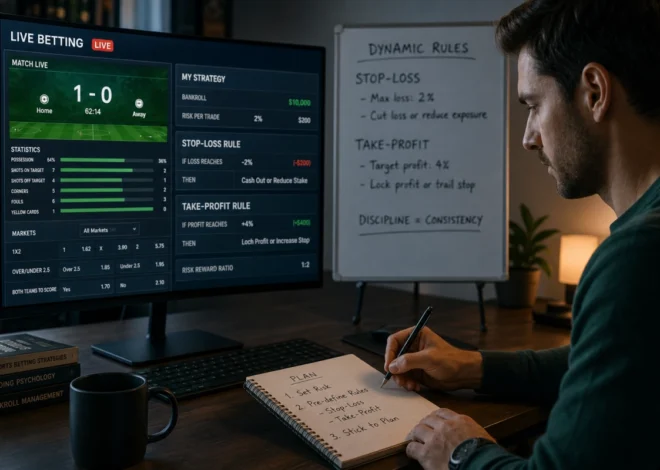
A practical guide to pre-defining and applying dynamic stop-loss and take-profit rules for live betting bankroll management

How to find the best live betting odds in-play: tools, latency and smart execution