

Real-Time Betting Odds API: How Betting Sites Stay Up to Date
Why up-to-the-second odds are essential for your sportsbook
You operate in an environment where a single injury update, weather change, or sudden market move can flip the value of a bet. Real-time odds aren’t a nice-to-have feature—they determine user trust, liability exposure, and your margin. When odds lag, you risk offering stale prices, losing arbitrage opportunities, or facing disgruntled customers who saw better odds elsewhere. Understanding how an API delivers live odds helps you choose the integration that keeps your platform responsive and competitive.
Real-time data affects several parts of your product simultaneously: the front-end display users see, the risk engine calculating liabilities, and the trading desk that hedges positions. You need an API that not only pushes new numbers quickly but also delivers contextual metadata (market states, event timestamps, and reason codes for changes). That contextual info is what lets you automate decisions instead of chasing manual adjustments.
How real-time betting odds APIs keep your platform synchronized
At a high level, real-time odds APIs provide a continuous feed of market updates. They do this through a combination of push technologies, data normalization, and prioritization. When you evaluate or integrate an API, look at the following technical and operational characteristics:
- Push vs pull delivery: Push mechanisms (WebSockets, Server-Sent Events, or proprietary TCP streams) send updates to you as they happen, which minimizes polling overhead and reduces latency. Pull models (periodic REST requests) are simpler but introduce lag and extra load.
- Latency and throughput: Understand typical end-to-end latency (milliseconds to seconds) and peak update rates. High-profile matches generate hundreds of updates per minute; your stack must handle bursts without dropping messages.
- Data normalization: Odds providers often cover the same market using different naming conventions and price formats (decimal, fractional, American). A good API normalizes markets and provides conversion metadata so your front end and risk systems see consistent values.
- Market depth and metadata: Beyond best prices, feeds may include ladder prices, available liquidity, market status (suspended, void, settled), and reason codes for changes (injury, start, manual adjustment). That data is critical for automated trading and customer transparency.
- Reliability and fallbacks: Look for guaranteed delivery features (message sequencing, retries, acknowledgements) and secondary endpoints you can failover to if latency spikes or a connection drops.
In practice, integration means deciding which endpoints to subscribe to, how to map incoming events to your internal market identifiers, and how to prioritize updates for active markets versus long-term futures. Next, you’ll want to explore specific architectural patterns, message formats, and best practices for keeping latency low while ensuring data integrity—details that determine how resilient and responsive your odds layer will be.
Architectural patterns for ingesting, processing, and serving live odds
Designing the plumbing between the odds provider and your customer-facing services determines how well you survive bursts, outages, and repeated retries. Two common, proven patterns are the snapshot+delta pipeline and the event-sourced stream approach—each tuned for different operational priorities.
- Snapshot + delta model: Providers publish periodic full snapshots of a market and then frequent delta updates for changes. Use the snapshot as an authoritative baseline on connect or after a detected inconsistency, and apply deltas in sequence to move the state forward. This minimizes state size in memory and simplifies recovery after missed messages.
- Event-sourced stream: Providers expose every change as an immutable event. You persist events to a durable stream (Kafka, Pulsar), process them into materialized views, and serve those views to downstream systems. This gives you complete auditability and enables replay for rebuilding state or backtesting trading logic.
Implementation details that matter:
- Partitioning and ordering: Partition streams by market or event ID so ordering per market is preserved. This keeps sequence handling simple at the consumer level and avoids cross-market locking.
- Hot path vs cold path: Route highly active markets to an in-memory cache layer (Redis, Aerospike) for sub-100ms read access, while lower-traffic markets can be served from a database-backed materialized view. This lets you scale memory and persistence independently.
- Backpressure and flow control: Implement admission control: allow subscribing services to limit update rates or receive coalesced updates during extreme bursts. Use TCP-level flow control plus application-level windowing to avoid overloading downstream processors.
- Failover topology: Maintain parallel ingestion links and cold standby processors that can take over with minimal catch-up time. Automate failover using health checks and leader election to reduce manual intervention.
Message formats, sequencing, and ensuring idempotent processing
How messages are encoded, sequenced, and acknowledged affects latency, bandwidth usage, and correctness. Prioritize compact, typed schemas and robust ordering metadata.
- Binary, schema-driven payloads: Use Protobuf/Avro for high-throughput links to keep payload size small and parsing fast. Include a version field so you can evolve schemas without breaking consumers.
- Sequence numbers and timestamps: Every update should carry a monotonically increasing sequence per market and an event timestamp. Consumers validate sequence continuity; gaps trigger a snapshot or replay request. Timestamping supports regulatory audits and latency measurements.
- Idempotency and deduplication: Make processors idempotent by keying updates on market+sequence or eventID and storing the last-applied sequence. That prevents double-application during retries or reconnects.
- Partial updates and tombstones: Support partial patches (only changed legs/prices) and explicit tombstone events for removed markets or voided bets so downstream state doesn’t retain stale entries.
Operational practices: monitoring, testing, and SLO-driven resiliency
Live odds systems must be observable and exercisable. Treat your odds layer like a core trading system with SRE practices around SLOs, synthetic testing, and automated reconciliation.
- Hum metrics and alerts: instrument update latency (P50/P95/P99), sequence gap rate, reconnect frequency, consumer lag, and reconciliation mismatches. Alert on stale feeds, elevated gap rates, or unexplained volatility spikes.
- Chaos and synthetic feeds: Routinely run fault-injection tests and use a synthetic feed that simulates tens of thousands of rapid updates to validate end-to-end behavior without risking live markets.
- Automated reconciliation: Periodically compare provider snapshots to your materialized views and auto-heal by reloading snapshots on mismatch. Log all reconciliation events for audit and post-mortem analysis.
- SLA and runbooks: Define SLOs for end-to-end update latency, allowable missed-update windows, and failover timing. Maintain clear runbooks for common incidents (sequence gaps, provider failover, market freezes) so operators can act quickly.
Putting real-time odds into production
When you move from prototype to production, focus on predictable behaviors rather than chasing absolute speed. Prioritize deterministic ordering, clear failure modes, and observable recovery paths. Start by proving your ingestion pipeline with a synthetic high-throughput feed, verify recovery with intentional sequence gaps, and validate downstream failover under load. Implement feature flags and phased rollouts so you can limit exposure while tuning caches, admission control, and reconciliation jobs.
- Instrument latency at multiple points (provider → ingestion → cache → UI) and set SLOs for each segment.
- Automate snapshot reloads on detected gaps and ensure your materialized views are rebuildable from the event stream.
- Provide a human-readable reason code and state for every market update so support and trading desks can act without ambiguity.
- Test failover paths regularly and keep runbooks current; practice restores and leader elections in non-production environments.
Final operational notes
Real-time odds are as much an organizational challenge as a technical one. Clear SLAs with providers, rigorous SRE practices, and cross-team playbooks (product, trading, risk, ops) reduce confusion when markets move quickly. For implementation details on push technologies that underpin low-latency feeds, see the WebSockets API documentation—it’s a practical primer for building robust, bidirectional streams that many odds providers use.
Frequently Asked Questions
How fast can real-time odds updates arrive and what affects that speed?
Updates can arrive in milliseconds to multiple seconds. Key factors are the delivery method (push vs pull), network distance, provider processing, message batching, and your own ingestion and cache latency. Measure P50/P95/P99 latencies end-to-end to set realistic SLOs.
Which delivery method is best for minimizing latency: WebSocket, SSE, or REST polling?
Push methods (WebSocket, Server-Sent Events, or dedicated TCP streams) are superior for low-latency, high-frequency updates because they avoid polling overhead and reduce round trips. WebSockets are widely supported and allow bidirectional communication; SSE is simpler for unidirectional streams. REST polling is simpler to implement but introduces higher and variable latency.
What should I do when I detect a sequence gap or missed updates?
Immediately pause applying deltas for the affected market, request the latest snapshot or replay events, and reconcile your materialized view against the snapshot. Use sequence numbers and idempotent processors to avoid inconsistencies, and have automated alerts and runbooks to trigger snapshot reloads when gaps exceed your threshold.

Related Posts
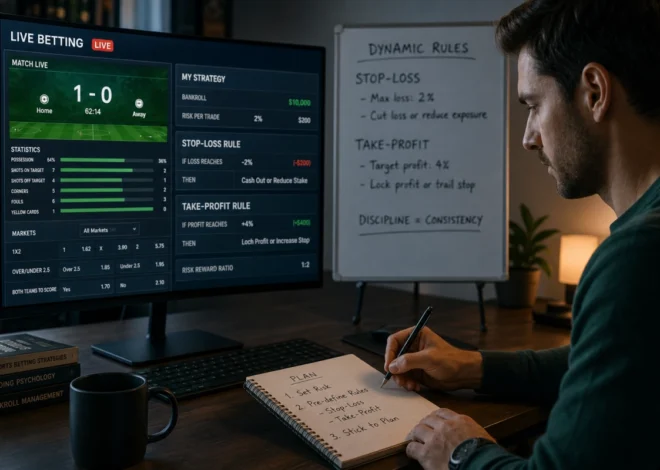
A practical guide to pre-defining and applying dynamic stop-loss and take-profit rules for live betting bankroll management

How to find the best live betting odds in-play: tools, latency and smart execution