A practical in-play guide to betting on red cards: how live odds move and when to act
How betting on red cards works in-play and why odds change fast
Betting on red cards is a niche in-play market that pays out if one or more players receive a red card during a match. Unlike pre-match props, in-play red-card markets react instantly to match events, referee behaviour and shifting probabilities. Understanding live odds, market depth and the match context helps bettors make faster, more rational decisions instead of guessing on emotion.
What live odds and in-play markets mean for red-card bets
Before placing any stake, readers should understand three basic terms:
- Live odds: Prices offered by bookmakers during a match that update as events happen. Shorter odds mean an event is more likely; longer odds mean it’s less likely.
- In-play markets: All bets that remain available after kick-off—these can include next card, next red card, whether a red will occur, and timing-based markets.
- Cash out: A bookmaker option to close a live bet early for a partial return. Cash-out values move with the market and are influenced by current likelihood and liability exposure.
Live odds for a red-card market change for predictable reasons: bookings, physical tempo, VAR checks, substitutions, and referee style. Odds shorten (become more attractive to take) after events that increase the chance of a red—e.g., a second yellow for a player, a nasty lunge, or a build-up of tempers in the closing stages.
Example: how a single event shifts the market
Imagine a match at 65 minutes, score level. A forward from Team A is booked for a reckless tackle. The immediate market reaction: prices for “any red card” may shorten slightly because the booked player is at risk of a second yellow. If that same player later commits another careless foul, odds will shorten sharply or markets (like next red card) will show clear value to bettors who react quickly.
When to consider placing stakes and when to avoid betting on red cards
Timing is everything. The right moment depends on match state, referee tendencies and time remaining. Practical patterns bettors should look for:
- Good moments to consider staking:
- After a player receives a first yellow and continues to play aggressively.
- Late in the match when players are fatigued and tension is high (added stoppage time increases risk).
- When a referee has already issued several yellows or shown a strict disciplinary pattern early on.
- Times to avoid betting:
- Early in the match with no disciplinary history—markets tend to overprice rare events.
- Matches officiated by referees known to avoid second yellows or send-offs for minor fouls.
- When market liquidity is thin and bookmakers widen spreads—cash-out offers can be poor and unpredictable.
Risk management is essential: use small, predefined stakes specific to red-card markets, and never chase losses. Decide in advance the maximum stake on these high-variance props and treat any potential cash-out as a tool to reduce downside, not a guaranteed profit extractor.
Next, the guide will examine concrete referee signals, tactical situations and statistical cues that raise red-card probability—plus a step-by-step live checklist for reacting to events and placing disciplined in-play bets.
Referee and match signals that foreshadow a red card
Referees are the single biggest live indicator for red-card likelihood. Rather than guessing, watch concrete signals that consistently precede sendings-off:
- Early carding pattern: A referee who issues two or more yellows in the first 30–40 minutes is signalling a lower tolerance for rough play—the chance of a second-yellow escalates.
- Escalating language and body language: Refs who shout, point to the book, or repeatedly hold up a yellow card are mentally primed to control the game with disciplinary measures. That temperament often leads to stricter follow-up decisions.
- Persistent fouling without mitigation: When a team commits a sequence of cynical fouls (time-wasting, studs-up tackles, shirt-pulling) and the manager makes no substitution to calm play, the likelihood of a red rises as frustration builds.
- VAR interventions and prolonged reviews: A VAR check that confirms a contentious foul or violent conduct increases immediate red-card probability—even if the ref initially shows only a yellow.
- Key player vulnerability: A star player booked early and then repeatedly targeted becomes a clear red-triangle candidate. Track who is on a yellow and who is marking them closely.
Combine referee cues with match state: close scorelines, derby intensity, and late-game tactical desperation all amplify those signals. The more signals align, the faster odds should shorten—if they don’t, the market may offer value.
Tactical situations and statistical cues worth watching
Certain tactical patterns and in-match statistics reliably correlate with higher send-off rates. Watch for these live:
- High foul/minute rate: If the fouls per 10 minutes spike above the match or league average, tempers and reckless tackles often follow.
- Numerical or positional imbalances: A late attacking substitution that leaves a team exposed at the back increases desperation fouls. Similarly, goalless games where teams risk everything show elevated red probability.
- Cumulative cards and fatigue: Multiple substitutions, especially defensive ones, can indicate a tired team. Fatigue raises mistimed tackles and professional fouls.
- Disciplinary profiles: Quick-reference stats—referee cards per game, teams’ season yellow/red rates, and head-to-head rivalry history—give context. If a referee averages 0.4 sendings-off per match and you’re watching a high-tension fixture, treat the implied baseline as meaningful.
A practical live checklist: when to stake, hedge, or cash out
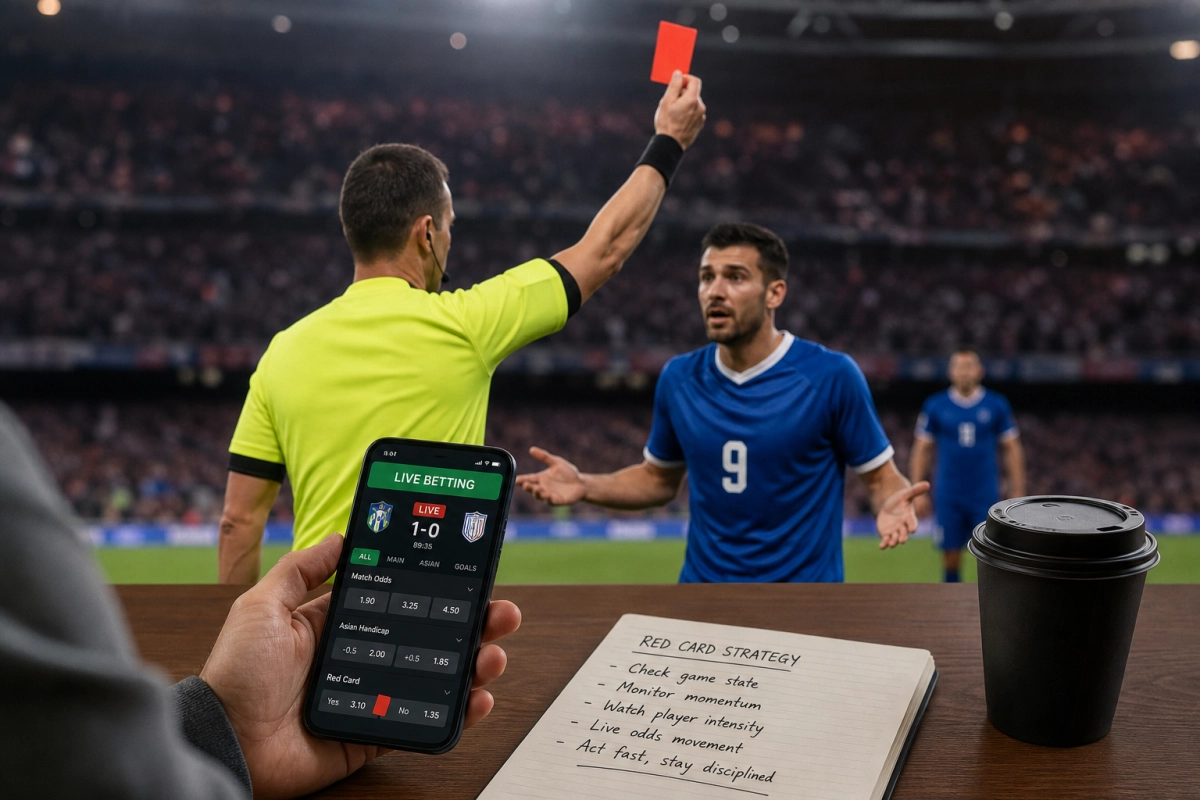
Use this step-by-step checklist to act quickly but disciplined during a match:
- Predefine stakes: Decide your fixed unit for red-card props (e.g., 0.5–1% of bankroll). Stick to it.
- Scan referee & cards: If the ref has shown multiple yellows or a player is on a yellow and being targeted, mark the match as watch-worthy.
- Check tactical triggers: Look for fatigue, late substitutions, VAR reviews, or tactical changes that increase risky challenges.
- Compare market value: If live odds imply a lower probability than your assessment—i.e., you judge a red 20–30% likely but the market prices it lower—consider staking immediately.
- Set thresholds for cash-out: Predefine a cash-out floor (for example, accept cash-out that returns ≥60% of max profit if less than 15 minutes remain and risk is high). For larger potential returns, consider partial cash-outs to lock some profit while keeping exposure.
- Hedge selectively: If the cash-out is poor but a lay bet or small opposite stake on a betting exchange limits loss effectively, hedge to control downside—only if fees and liquidity make sense.
- Exit rules: No-chase policy: if the match drifts away from your anticipated scenario (ref calms down, target player substituted, market odds lengthen), close or reduce exposure immediately.
These practical steps make reactive in-play betting systematic rather than emotional. In the next part we’ll cover sample live trade scenarios and how to size hedges for different bankrolls.
Final playbook: mindset, discipline and next steps
Betting on red cards in-play rewards discipline more than bravado. Treat each live decision as a small, reversible experiment rather than a last-chance bet. Keep stakes modest, follow rules you can actually stick to, and accept that variance will be high even when your process is sound.
Focus on process improvements: record every trade, note what you saw (referee cues, tactical triggers, timing) and how the market reacted. Over time, that log will separate useful patterns from lucky guesses and help you adjust stake-sizing and cash-out thresholds rationally.
Rules to live by
- Predefine stake and cash-out boundaries before each match—decisions are faster and clearer when they’re made in advance.
- Prioritise referee signals and market movement over gut feeling; act quickly when objective triggers align.
- Use low stakes to test hypotheses in-play; scale only when you have consistent, repeatable edges.
- Don’t chase: if your scenario evaporates (player substituted, ref calms), close exposure immediately.
- Review and adapt: short, focused post-match reviews create long-term edge more reliably than instinctive reactions.
Stay patient and treat red-card betting as a specialist skill. With disciplined risk management, honest record-keeping and a calm, rules-driven approach, you’ll make clearer decisions in-play and protect your bankroll while you learn.