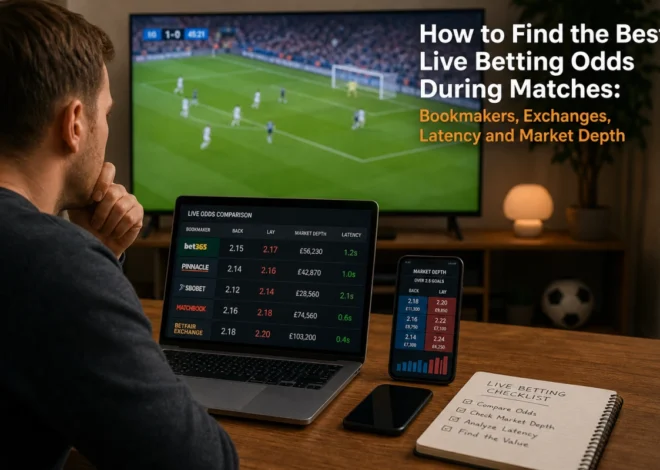

How Live Betting Odds Show Momentum: A Practical, Sport-Specific Guide
Reading live betting odds to track market sentiment and momentum
Live betting odds change because the market reacts to events, statistics and perceived momentum. This guide explains how to interpret live betting odds in real time, what small and large moves can mean, and concise checks bettors can run during football, basketball and tennis matches. It defines essential terms like live odds, in-play markets, cash out, match momentum, handicap, totals, next goal and next point before moving to practical thresholds and immediate actions.
Core concepts: how odds translate to market belief
Live odds are the bookmaker’s current prices for outcomes while a game is in progress. Converting decimal odds to implied probability helps quantify market sentiment: implied probability = 1 / decimal odds. For example, odds of 2.50 imply a 40% chance (1 / 2.50 = 0.40). When live odds shorten (fall), the market is assigning a higher probability to that outcome; when they lengthen (rise), perceived probability drops.
In-play markets include match result, handicaps, totals (over/under), and micro-markets like next goal or next point. Cash out lets bettors settle a position early based on current live odds and the bookmaker’s offered price.
Why odds move: events and information flow
- Observable events: goals, baskets, breaks of serve, injuries, red cards and substitutions.
- Statistical momentum: xG pressure, successive shots on target, scoring runs, time of possession and serve percentages.
- Market factors: sudden volume on one side, sharp bookmaker corrections, or large hedging by professional traders.
- Contextual factors: weather, crowd influence, visible fatigue, or tactical changes.
Quick real-time checks and starter thresholds bettors can use
Before acting, bettors should run a short checklist. These checks are practical starting points — they should be adapted and tested against each bettor’s experience and bankroll rules.
- Baseline: note the pre-match odds and convert to implied probability.
- Immediate change: if live odds move enough to change implied probability by 5–10 percentage points within 5 minutes, flag the event as significant; 10–20+ points is a strong market signal worth deeper scrutiny.
- Event cross-check: match the timing of the odds move to a specific observable event (goal, red card, timeout, injury, service game break).
- Stat confirmation: confirm momentum with live stats — shots on target, corners, possession, scoring run length, serve win rate or break point opportunities.
- Liquidity check: if odds shift rapidly but volume is low (thin market), treat moves with caution — bookmakers may be adjusting to limited bets rather than broad market consensus.
Sport-specific adaptations matter: a 10% implied-probability swing after a red card in football usually has different predictive value than the same swing after a single double fault in tennis. Next, the article will present sport-specific thresholds and step-by-step in-play examples for football, basketball and tennis so readers can practice these checks during live matches.
Football: specific thresholds for goals, red cards and next-goal markets
Set sport-specific thresholds around the most game-defining events. In football those are goals, red cards and sustained xG pressure. Practical thresholds to watch live:
– Immediate-impact threshold: a single goal or a straight red that moves match-winner implied probability by 8–15 percentage points within 3–7 minutes is a clear market reaction. 15+ points is a strong structural change.
– Short-run momentum: two high-xG shots or an 8–10 minute sustained attack sequence that produces a 5–8 point swing is a medium signal.
– Next-goal micro-market: if next-goal odds shorten to ≤2.20 (≈45% implied) for one side after that side earns repeated corners or shots on target, treat as directional momentum rather than luck.
Step-by-step football example
1. Baseline: pre-match favoured Team A at 1.90 (≈52.6%), Team B 3.80 (≈26.3%).
2. Event: 30’ Team B scores; market shifts—Team B match-winner to 2.75 (≈36.4%), Team A to 2.30 (≈43.5%). Implied-probability swing for Team B ≈10 percentage points in 3 minutes — flag it.
3. Quick checks: confirm goal context (penalty, counter, defensive error), check live stats (Team B now has 6 shots, 3 on target; xG map shows pressure), check liquidity (bookmaker accepted multiple bets or cancelled/limited stakes?).
4. Action: if pressure persists and next-goal odds for Team B shorten to ≤2.50, consider a small-size in-play trade (1–2% bankroll) on Team B or a next-goal bet. If red card follows and market swings another 12+ points, increase conviction and consider larger exposure (capped to bankroll rule).
5. Exit rules: predefine cash-out or hedge if implied probability reverses by half of the initial swing or if the opposing side begins equalizing stats (shots on target flip, xG momentum reverses).
Basketball: reading scoring runs, quarter swings and spread movement
Basketball is high-frequency; treat consecutive possession outcomes as the primary signal. Useful thresholds:
– Short-run swing: a 6–12 point run over 3–6 minutes that moves the moneyline implied probability by ~8–12 percentage points or the live spread by 1.5–3 points is actionable.
– Quarter reset: odds moves in the first 2 minutes of a quarter often overreact; moves later in the quarter are more informative.
– Totals and pace: a sustained increase in possessions per 5 minutes (shot-clock usage down, fast-breaks up) that shifts over/under projections by 3+ points for the remainder of the game is significant.
Step-by-step basketball example
1. Baseline: Team X -3 (1.85) vs Team Y +3 (2.05).
2. Event: late in 2nd quarter Team Y goes on a 10–0 run; live spread flips to Team X +1.5 and Team Y moneyline shortens from 2.05 (≈48.8%) to 1.70 (≈58.8%) in 4 minutes.
3. Quick checks: confirm lineup change (bench to starter), fouls, injuries, shooting splits (Team Y 65% on twos in run), bookmaker liquidity (size limits).
4. Action: fade overreactions early in quarters but take directional bets when run is backed by rotation/efficiency changes. Use smaller stakes if movement happened within 30 seconds (possible thin market) and larger if consistent over multiple bookmakers.
5. Hedge/exit: protect bets if the opponent stops the run and forces split possessions or if key player picks up a foul.
Tennis: serve-break dynamics, momentum after breaks and micro-market timing
Tennis momentum is tightly linked to serve holds and break opportunities. Thresholds:
– Break impact: a break of serve that changes match-win implied probability by 8–12 points (or a set-break that changes set-win by 15+ points) is a material shift.
– Point-run: winning 4–6 consecutive points on opponent’s serve (break point pressure) that shortens next-game odds to ≤2.00 is a high-confidence signal.
– Game-inflation risk: small markets (next-game) can be volatile with low liquidity; prefer match-winner moves backed by stats.
Step-by-step tennis example
1. Baseline: Player A 1.60 (62.5%) serving first set.
2. Event: Player B breaks early; Player B match-win odds move from 2.20 (≈45.5%) to 1.90 (≈52.6%) within 2 games — ≈7-point swing.
3. Quick checks: verify injury/time-wasting, first-serve% dip (Player A drops from 65% to 45%), return winners rising, bookmaker bet limits.
4. Action: if Player B consolidates break and first-serve% remains low, place a small-to-medium size bet on Player B for set or match (1.5–3% bankroll). For next-game markets, wait one service game to confirm momentum.
5. Exit rules: cash out or hedge if Player A regains serve efficiency (first-serve% back above 60%) or if break was an outlier (lucky return or net-cord winner).
A short, actionable in-play routine to start using today
- Pre-match: record pre-match odds and implied probabilities for the markets you plan to follow.
- Trigger check: when an event occurs (goal, break, run, red card), convert new odds to implied probability and compare the swing to your threshold (e.g., 5–10 points = inspect; 10+ = act).
- Confirm: immediately check live stats (shots, xG, serve%, rotations), visible context (injury, substitution, timeout) and liquidity (limits or cancelled bets).
- Stake: size bets based on a pre-set rule (e.g., 1–3% bankroll for standard signals; scale up within strict caps for repeatable, high-confidence moves).
- Exit: set clear exit rules before placing the bet (cash-out/hedge when reversal reaches X points, or lock in profit at Y% gain) and stick to them.
- Review: log every in-play decision with the event, odds, stake, result and short notes; review weekly to refine thresholds and process.
Common pitfalls and discipline checks
- Don’t chase losses or increase size after a bad streak; maintain bankroll rules.
- Beware thin markets—large odds swings with no parallel volume or multiple-bookmaker confirmation are unreliable signals.
- Avoid overfitting thresholds to one memorable match; require replication across several events before increasing conviction.
- Keep emotions out of split-second decisions: if you feel rushed, step back and apply the checklist before acting.
Bringing it together
Live odds are a continuous flow of market information — useful only when paired with a disciplined process. Treat thresholds and checks as working tools that you must test, adapt and enforce. Start small, keep a clean log, and focus on repeatable decisions rather than one-off wins. Over time the combination of objective checks, strict stake management and calm execution will let you translate odds movements into actionable, risk-controlled in-play trading or betting.

Related Posts
A practical in-play guide to betting on red cards: how live odds move and when to act
A Practical Step-by-Step Guide to Building a Repeatable Live Betting Bankroll System