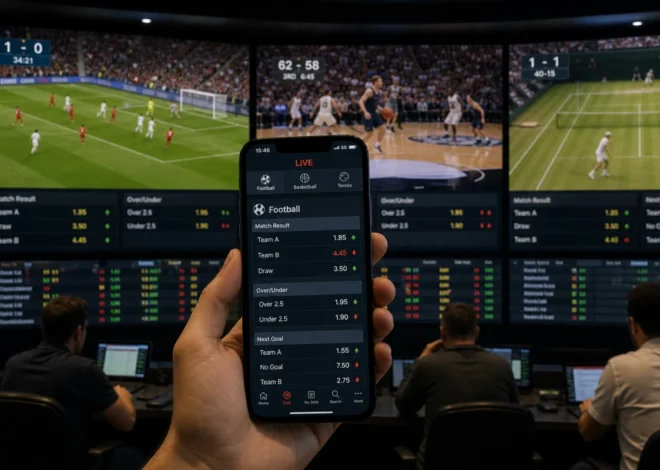

How to Use Live Odds Today to Improve Your Betting ROI
Why monitoring live odds today is essential if you want better ROI
You probably know pre-match lines are useful, but live odds are where market efficiency and opportunity converge in real time. When you track live odds today, you gain access to the market’s immediate reaction to events — injuries, weather shifts, momentum swings, substitutions, or sudden influxes of bets. Those reactions create short windows where implied probability diverges from the true probability you calculate, and those divergences are where you find value.
Using live odds effectively helps you do three things that directly improve ROI: capture transient value, manage exposure through hedging or cash-out, and exploit market inefficiencies before they close. You’ll also reduce variance by making smaller, better-informed in-play bets rather than oversized, emotion-driven wagers.
How live odds move and what those movements tell you
Understand implied probability and price change
Every live price is an implied probability. Converting odds to probability lets you compare the market’s expectation to your model or read of the game. For decimal odds, implied probability = 1 / odds. If your assessment of an event’s true probability exceeds the market’s implied probability, you’ve identified value. When odds shorten (price drops), implied probability increases; when odds lengthen (price rises), implied probability decreases.
Key signals to watch in live markets
- Sharp movement against public expectation: If odds move significantly without an obvious public-facing reason (no goal, red card, injury), it often indicates sharp money or professional bettors influencing the market.
- Fast, short-lived swings: Sudden lurches followed by reversions can be caused by data-feed errors or mispriced liquidity. These can offer high-risk, high-reward opportunities but require speed and discipline.
- Line compression: When multiple bookmakers quickly align on a new price, the window for value narrows — you need better odds or faster reactions to profit.
- Volume vs. volatility mismatch: Big odds movement with low betting volume tends to be noise; big movement with high volume is more meaningful.
Practical mechanics: liquidity, latency, and bookmaker behavior
Live markets differ by sport, league, and bookmaker. High-liquidity matches (major soccer leagues, NFL) have thinner edges and faster adjustments; niche markets have wider lines and slower pricing, which can favor skilled traders. Latency — how quickly you see updated odds — is critical: the faster your feed or app updates, the better your chance to act before the market corrects. Finally, some bookmakers react faster to public money, while exchange-style markets reflect matched bets and can expose sharper pricing trends you can follow.
With these foundational ideas in mind — what live odds represent, which movements matter, and how market structure affects opportunity — you’re ready to move on to concrete strategies and tools that let you turn those signals into higher ROI in practice.
Actionable in-play strategies that convert live odds into ROI
Knowing how odds move is one thing; acting on them profitably is another. Below are concrete in-play strategies that, when applied with discipline, convert short-lived market inefficiencies into measurable ROI.
- Scalp momentum after clear events: When the underlying event (goal, red card, major injury) clearly shifts the win-probability, markets often lag slightly. Example: a home team scores and the away money momentarily shortens away odds. If your model shows the home win implied probability still undervalued after the goal (accounting for time remaining and expected scoring), place a small, quick back bet. Target short holding periods and modest edge sizes — you’re trading probability re-pricing, not predicting new fundamentals.
- Fade overreactions: The public frequently overreacts to single events. If odds swing dramatically on an ambiguous incident (close chance or refereeing call) without a corresponding lasting change in match-state, consider fading the move. Use a pre-defined trigger (e.g., >20% implied-probability change within 2 minutes with no score change) and keep stakes conservative — these are higher-variance plays.
- Cross-market hedging and arbitrage: Live markets for related props (next goal, total goals, corners) can move slower than match-winner lines. You can layer positions across correlated markets to lock profit or reduce downside. Example: Back Team A to win pre-game, then if they concede early and the match-winner price lengthens but the “next goal” market offers good value for Team A, back the next-goal and hedge part of your original stake.
- Lay trades on exchanges: Betting exchanges let you both back and lay. If you identify a price you think is too short, lay it and wait for the market to revert. Exchanges are particularly valuable for execution and hedging since you can set limit orders and avoid bookmaker cash-out fees.
- Structured staking and quick exit rules: Use a smaller fraction of your bankroll per live trade than pre-match bets. Consider 0.5–1.5% as a baseline depending on confidence; use a fractional Kelly (e.g., 10–25% Kelly) to control volatility. Define exit points: partial cash-out at X% gain or full exit at Y% loss. Speed and discipline here protect ROI.
Tools, workflow, and execution: turning signals into consistent profit
Execution quality separates good ideas from profitable ones. Build a workflow and toolkit that minimizes latency, captures relevant data, and enforces decision rules.
- Odds sources and speed: Use a combination of bookmaker apps, an exchange (e.g., Betfair), and a reliable odds API or comparator to spot discrepancies. If speed matters, use a VPS close to your odds-provider or a low-latency feed; avoid mobile-only interfaces for high-frequency plays.
- Automation vs. manual: Automate alerts and simple trigger-based orders (price threshold, volume spike), but keep higher-conviction judgment calls manual. Bots are great for arbitrage and scalping when you can’t react instantly; they’re risky if you can’t maintain multiple funded accounts or manage limits.
- Pre-game checklist and real-time dashboard: For every live opportunity, have a short checklist: current implied probability, model edge, max stake, stop-loss, and exit plan. Display live match stats (possession, expected goals, time) alongside odds so your decisions are data-driven, not emotive.
- Recordkeeping and review: Log every live trade with rationale and outcome. Weekly reviews expose recurring mistakes (poor timing, stake creep) and help refine trigger thresholds to improve long-term ROI.
With defined strategies and a disciplined execution workflow, live odds today stop being noise and become a steady source of edge. Next, we’ll look at advanced position-sizing and portfolio management to further stabilize returns.
Advanced position-sizing and portfolio management
To stabilize returns and reduce drawdowns, treat your live-betting activity as a tradable portfolio rather than isolated bets. Combine robust sizing rules with diversification across markets and predefined risk limits.
- Use a fractional Kelly approach for sizing: calculate a full-Kelly stake from your edge and variance, then apply 10–25% of that to limit volatility. For simpler rules, 0.5–1.5% of bankroll per live trade is a practical baseline.
- Diversify by market and strategy: mix scalps, hedges, lay trades, and prop-driven plays so a single event type doesn’t dominate risk.
- Set portfolio-level limits: daily and weekly loss caps, max concurrent open positions, and a maximum exposure to any one market or event.
- Rebalance and review: run rolling performance reports (ROI, strike rate, average hold, max drawdown) and adjust trigger thresholds or stake sizes every 4–8 weeks based on outcome.
- Model and stress-test scenarios: simulate sequences of losses and winning streaks to ensure your bankroll can handle streak variance without forcing poor decisions.
- If you need a primer on the math behind sizing, read a concise primer like Kelly criterion overview and adapt it conservatively to live betting realities.
Putting live odds into disciplined practice
Live odds create opportunity only when matched with discipline. Build simple, repeatable routines: pre-game setup, real-time checklist, conservative sizing, and honest post-game review. Focus on improving execution — faster data, cleaner rules, better recordkeeping — rather than chasing bigger edges. Over time, consistent small advantages compound into measurable ROI improvements while keeping emotional and financial risk contained.
Frequently Asked Questions
How much of my bankroll should I risk on a single live bet?
There’s no one-size-fits-all answer, but a conservative approach is to risk 0.5–1.5% per live trade depending on confidence and strategy. If you use Kelly sizing, apply a fractional Kelly (10–25%) to reduce volatility. Also enforce daily and weekly loss limits so a string of bad outcomes doesn’t force poor decisions.
Are betting exchanges always better for live execution?
Exchanges offer advantages — the ability to lay, set limit orders, and often better transparency — which can improve execution and hedging. However, liquidity varies by market and time, and fees/commission structures differ. Use exchanges where liquidity and spreads support your strategy, and rely on bookmakers or multiple sources when exchanges are thin.
How can I avoid emotional overtrading during in-play markets?
Prevent overtrading with predefined triggers, stake limits, and a brief decision checklist (implied probability vs. model edge, max stake, stop-loss). Automate alerts for setups you trust, log every trade with a reason, and enforce mandatory breaks after a set number of trades or losses. These habits keep judgment clear and protect ROI.

Related Posts
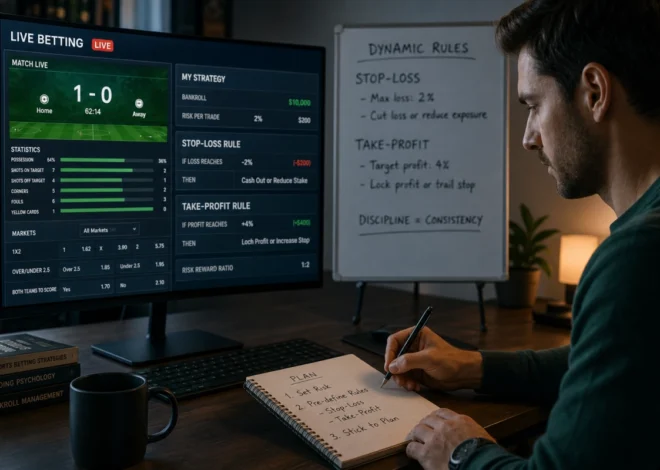
A practical guide to pre-defining and applying dynamic stop-loss and take-profit rules for live betting bankroll management

How to find the best live betting odds in-play: tools, latency and smart execution