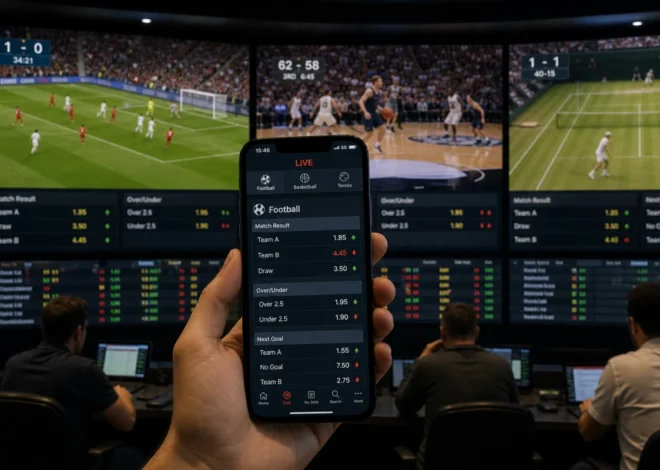

In-Play Betting Odds Tips: Maximize Value During Matches
How live match dynamics create opportunities you can exploit
When a match is underway, the odds you saw pre-game rarely tell the full story. You can gain an edge by watching how events — goals, injuries, substitutions, and momentum swings — immediately reshape bookmaker pricing. In-play markets react fast, sometimes overshooting or lagging behind actual probability shifts. If you understand what drives those moves, you can identify moments when the bookmaker’s price offers value relative to your assessment of the true chance an event will occur.
In practical terms, value means finding odds that are higher than the outcome’s implied probability. For example, if you estimate a team has a 40% chance to score in the remaining 20 minutes but the market is pricing that chance at 30%, there’s value. Your job is to build a consistent process to make those assessments quickly and accurately while matches evolve.
Core in-play concepts to watch so you can act with confidence
Read the game state, not just the scoreline
Score alone is a blunt instrument. You need to interpret context: which team is controlling possession, where shots are coming from, the quality of chances, and how fatigued or frustrated players appear. Use those signals to adjust your expected probabilities. A late corner count or sustained pressure is often more predictive of an imminent goal than the current score suggests.
Understand implied probability and price movement
- Convert odds to implied probability so you can compare your model to the market. Decimal odds of 3.00 imply a 33.3% chance.
- Watch for rapid price shifts after events; sharp moves can indicate new information or heavy money. Small, steady moves often reflect consensus updates and are harder to exploit.
- Be cautious of overreactive markets after emotional events (red cards, stoppage-time misses); these can create short-lived value if you act quickly.
Pick the right markets and manage exposure
Not all in-play markets offer the same potential for value. Markets like next-goal, Asian handicap live lines, and player-specific props can be more reactive and less efficient than main match-winner markets. Select markets where you can realistically interpret live data and where liquidity allows you to enter and exit positions without massive slippage.
- Size stakes smaller during volatile periods and scale up when your conviction is backed by clear, objective signals.
- Use pre-set stop-loss or staking rules to prevent emotional over-betting after a bad run.
With these foundations—reading context, converting odds to implied probability, and choosing the right markets—you’ll be prepared to look for edges as matches unfold. Next, you’ll get practical, step-by-step in-play strategies and examples that show exactly how to turn those edges into profitable bets.
Actionable in-play strategies: step-by-step frameworks
Below are three concise, repeatable frameworks you can apply live. Each is designed to be quick to execute and to fit the types of signals you’ll spot from watching the match rather than relying solely on pre-game models.
1) Momentum scalping (short-term edges)
- Trigger: Team A dominates territory and has 3+ high-quality chances in 10 minutes but score remains 0–0.
- Assess: Convert the market price for “Team A to score next” to implied probability. If odds are 4.00 (25% implied) and you judge the near-term chance at ~40%, that’s value.
- Stake: Use a small, fixed fraction of your bankroll (e.g., 0.5–1%) to capture the short-term move; plan to take profit or hedge within 10–30 minutes.
- Exit: If the market shortens quickly, take a partial profit; if the team creates no further chances after 15 minutes, cut the loss per your stop rule.
2) Event-triggered contrarian (fade overreaction)
- Trigger: Sudden market panic — a red card or a late miss causes the underdog’s odds to drift dramatically.
- Assess: Ask whether the event genuinely changes scoring probabilities or just market emotion. If a late substitution increased the opponent’s xG only marginally, the drift may be overdone.
- Action: Back the asset if your model shows the implied probability is now lower than reality. Use smaller stakes and tighter stops than usual; these fades are high-risk but can be high-reward.
3) Progressive hedge on Asian lines (manage swings)
- Trigger: You’re holding a live Asian handicap position and the market flips after a goal or injury.
- Assess & Rebalance: If your original position now has significantly worse EV, layer a hedge at the new price to reduce exposure while preserving some upside.
- Exit: Close the hedge when the market reverts or when your pre-set profit/loss threshold is met.
Concrete example — next-goal market: Suppose you back Team B to score next at 3.50 (28.6% implied) with a 1% stake because they’ve had several late corners and sustained pressure. Five minutes later the market shortens to 2.20 (45.5%) after a big chance; you can either cash out for a profit or lay a smaller stake at 2.20 to lock in a partial guaranteed return. The math is simple: pre-calc your hedging stakes so you know exactly how much profit you’ll lock in.
Staking, hedging, and managing risk during live play
In-play volatility demands disciplined bankroll and exposure rules. Without them, even a positive edge can be erased by one bad event or emotional over-betting.
- Staking: Prefer fractional Kelly for live use — typically 10–25% of full Kelly — to balance growth and drawdown control. If Kelly suggests 2% of bankroll, a live stake of 0.2–0.5% is often more practical.
- Max exposure: Cap exposure per match (e.g., 5% of bankroll across all live positions) and per market (e.g., 2% per single outcome) to avoid concentrated losses on unpredictable swings.
- Stop-loss rules: Implement session and per-bet stop-losses (for example, stop after losing 3% of bankroll in a session). Automatic limits prevent tilt and force reassessment.
- Hedging: Plan hedges before you place a live trade. Know the exact stake to lay at given odds to lock profit or limit loss — treat hedging as part of the trade, not a rescue operation.
- Record-keeping: Log every live trade with trigger, odds, stake, and outcome. Patterns in failures (e.g., overtrading after conceding) are fixable only if tracked.
Applying compact frameworks and strict money management will keep you in the game long enough to exploit recurring in-play inefficiencies. The next section will walk through layered examples and screenshots (conceptual) showing the step-by-step math behind common in-play maneuvers.
Putting live-edge skills into practice
Developing consistent returns from in-play betting is more about rehearsal and routines than about rare insights. Treat every match as a training opportunity: practice your read-rules, rehearse hedges, and reinforce bankroll limits until they become automatic. Over time the speed of your decisions will improve, and your ability to spot transient market inefficiencies will become the differentiator.
- Daily drills: pick one league and focus solely on the same two markets (for example, next-goal and live Asian lines) for several matches to build pattern recognition.
- Paper-trade or use tiny stakes for new strategies until your edge and execution are proven in your log.
- Pre-calc hedge matrices for common odds moves so you can act without on-the-spot math under stress.
- Review sessions weekly — track triggers that worked, ones that didn’t, and adjust your stop-loss and sizing rules accordingly.
- Keep learning: combine match footage with live-data metrics (possession, expected goals) and authoritative resources like Pinnacle Betting Resources to refine judgment and discipline.
Frequently Asked Questions
Which in-play markets are most likely to offer exploitable value?
Markets that move rapidly on short-term signals and are less efficient tend to offer the most opportunities: next-goal, live Asian handicap lines, and certain player props. These markets are often more sensitive to immediate match events (corners, sustained pressure, substitutions) and can misprice short-term probabilities. Main match-winner markets are usually more liquid and efficient, so value is harder to find there.
How should I size stakes during volatile live periods?
Use conservative fractional Kelly sizing (typically 10–25% of full Kelly) for live trades and cap exposure per match and per market (for example, a max of 5% of bankroll per match and 2% per outcome). Reduce stakes after large in-play events or when your confidence drops, and enforce session-level stop-losses to avoid emotional cascades.
What’s the safest way to practice in-play strategies without risking significant bankroll?
Start with paper trading or micro-stakes to validate your triggers and hedging math. Backtest ideas on historical match data where possible, and run structured review sessions to identify recurring mistakes. Use demo accounts or trackers to simulate trades and only scale stakes when your log shows a consistent positive expectancy and disciplined execution.

Related Posts
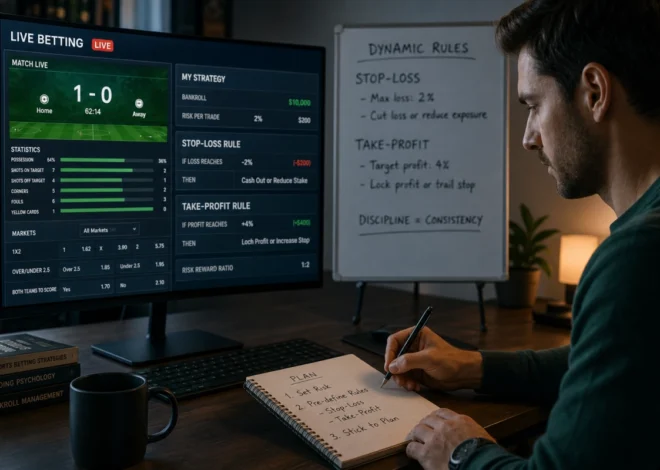
A practical guide to pre-defining and applying dynamic stop-loss and take-profit rules for live betting bankroll management

How to find the best live betting odds in-play: tools, latency and smart execution