A practical guide to pre-defining and applying dynamic stop-loss and take-profit rules for live betting bankroll management
Live betting bankroll management: why pre-defined stop-loss and take-profit rules matter
Live betting bankroll management treats in-play wagering like trading: set rules before the action unfolds. Defining stop-loss and take-profit levels ahead of time prevents emotional decisions during fast-changing matches and keeps risk within a pre-set budget. Below are core concepts, practical templates, worked examples and implementation tips for disciplined live betting.
Core terms every live bettor should know
Before rules, here are concise definitions of common live-betting vocabulary:
- Live odds – the current price offered by the bookmaker for an in-play market; they change as events unfold.
- In-play markets – markets available during a match (match winner, next goal/point, totals, handicaps, props).
- Cash out – a bookmaker feature to close a bet early for a guaranteed return or loss.
- Match momentum – shifts in pressure, possession or scoring that typically move live odds.
- Next goal / next point – short-term markets concentrated on the immediate next scoring event.
- Live statistics – real-time metrics (possession, shots, serve %, break points) used to assess odds.
Types of pre-defined exit rules and how they work
Dynamic exit rules cluster into three practical categories: percentage-based limits, event-triggered exits and time-based rules. Each suits different sports and market types and helps remove on-the-fly emotions.
Percentage-based stop-loss and take-profit
Set fixed percentages of bankroll or session funds to limit losses or secure gains before pausing activity.
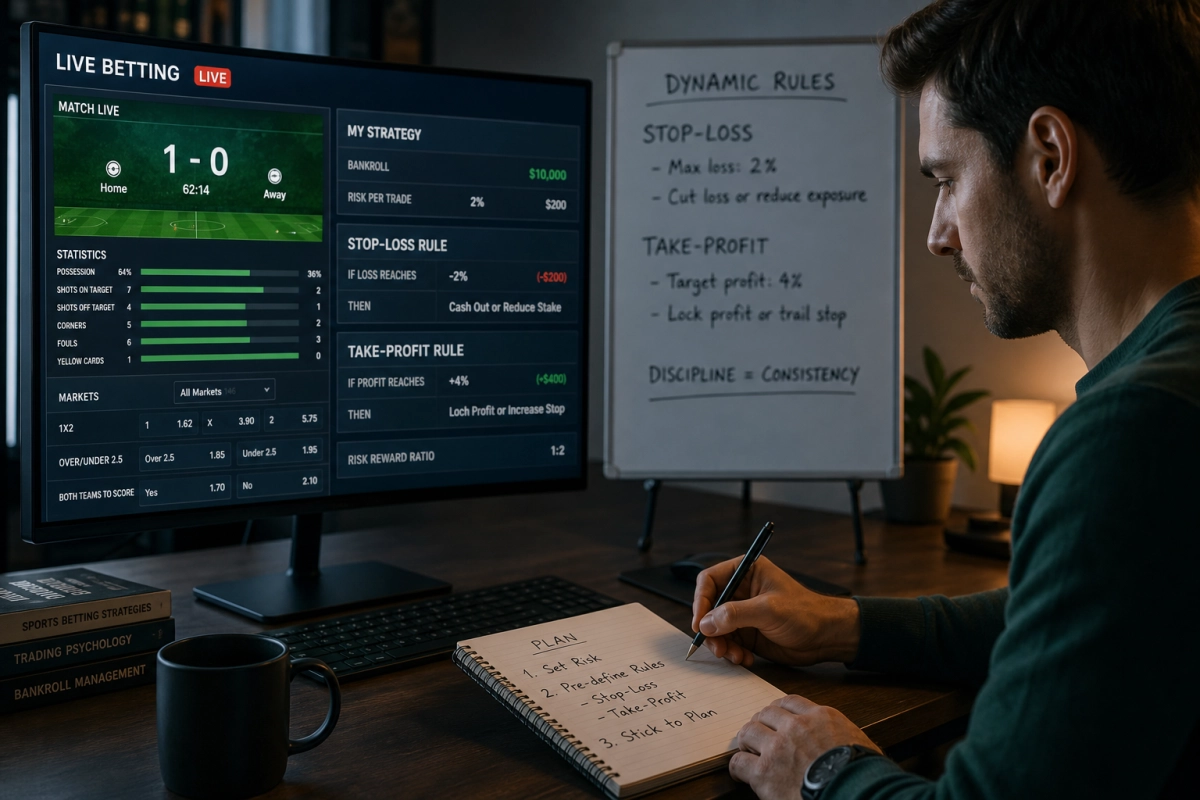
- Session rule example: stop-loss = 3–5% of bankroll; take-profit = 5–10% of bankroll. (If bankroll = $1,000, stop at $950 or cash out near $1,050–$1,100.)
- Per-bet dynamic: use trailing take-profit—when running profit reaches +8% lock in half and trail the remainder at +4% to protect gains.
- Benefit: simple, removes emotion and is easy to track with a spreadsheet or app alerts.
Event-triggered exits
Activate rules when a match event materially shifts probability: goal, red card, injury, substitution, timeout or a big scoring run.
- Football: cash out or reduce stake if your backed team concedes or the opponent gets a red card and implied probability swings beyond a threshold (e.g., >15%).
- Basketball: exit or trim next-quarter exposure if the opponent goes on a sudden 10–0 run and key players pick up fouls.
- Tennis: partially cash out when serve is broken on a break point and win probability drops; hold only if serve stats still favor the player.
Time-based rules
Close or reduce exposure at pre-defined time checkpoints to avoid late-game volatility in short-term markets.
- Examples: stop backing next-goal markets after 75% of match time, reassess at halftime or quarter breaks, and close short-term markets before the final 10 minutes unless hedged.
- Time gates are especially useful for quick markets (next point/goal) and when match context becomes decisive.
Practical templates: combining percentage, event-triggered and time-based rules
Choose a template that matches your appetite and adapt numeric thresholds to your bankroll and experience. Templates blend session limits, per-bet sizing and exit triggers.
- Conservative (recreational)
- Session stop-loss: 3%; take-profit: 6%.
- Per-bet exposure: 1% of bankroll; use fractional Kelly (≤10%).
- Event triggers: cash/reduce if implied swing >12% after a key event.
- Time rules: close short-term markets after ~75% elapsed. Lock-in: at +6% close 50% and trail rest at +3%.
- Balanced (serious hobbyist)
- Session stop-loss: 5%; take-profit: 10%.
- Per-bet stake: 1.5–2.5% depending on edge.
- Event triggers: partial cash out for medium swings (≈20%), full exit for larger swings.
- Time rules: reassess at breaks; lock-in at +12% (take 40% and trail at +6%).
- Aggressive (experienced, high-frequency)
- Session stop-loss: 7–10%; take-profit: 15–20%.
- Per-bet exposure: 3–5% with strict event-based exits.
- Event triggers: immediate exit/hedge on large swings (>25%) or injuries; close short-term markets before last 10 minutes unless hedged.
- Lock-in: at +20% take 50% and trail remaining at +10%.
Sport-specific worked examples: applying templates in-play
Short examples showing template actions during events.
- Football (balanced) — Back Team A at 2.20 (implied 45%) with a 2% stake. After conceding odds drift to 3.00 (33%); implied swing ≈12% so partial cash out 50% to recoup stake and leave a reduced position to chase a comeback. If pressure shifts at halftime, consider a small hedge to lock a profit/loss band.
- Basketball (conservative) — Back a moneyline at 1.90 in Q1. Opponent runs 10–0 and a key player picks up fouls; the pre-set 12% swing is met. Action: exit next-quarter markets and reduce live prop exposure; re-enter only after timeout or substitution shows a momentum reversal.
- Tennis (balanced/aggressive mix) — Back a server at 1.60, he loses serve on a break point and the match goes decisive. Reduce stake after the break and only trail if first-serve % remains high (>60%). Cash partial if odds widen beyond an 18% implied swing.
Step-by-step implementation and simple tracking tools
Turn templates into disciplined action with lightweight tools and a short checklist.
- Pre-session setup: record starting bankroll, chosen template, session limits and stake table.
- Live tracking spreadsheet: columns for Date, Event, Market, Pre-odds, Stake, Cash-out, New odds, Action, Bankroll. Include formulas: implied probability = 1/odds and swing = ABS(PreProb-NewProb).
- Alerts & timer: enable push-notifications for cash-out levels and use timers for half-time/quarters/last-10-minutes.
- Hedge decision tree: if adverse swing >X% and exchange lay saves ≥Y% of stake → hedge; else partial cash out.
- Post-session review: log outcomes, compute session ROI, compare to session limits and adjust thresholds only after a controlled sample of sessions.
These tools make exits objective and repeatable. Test templates on small stakes before scaling.
Refining thresholds and simple automation to enforce rules
Iterative threshold tuning
Treat stop-loss and take-profit thresholds as hypotheses. Run 10–30 controlled sessions, record outcomes and adjust based on measured variance and edge rather than single-session emotion. Prefer percentile-based adjustments (e.g., tighten after the worst 10% of sessions) and use moving averages of ROI and drawdown to guide incremental changes. If using Kelly, re-calculate edge periodically and cap the fraction to avoid overbetting in volatile live markets.
Simple automation and alert ideas
Automation can be lightweight yet effective; the goal is faster, consistent reactions.
- Spreadsheet logic: compute implied probabilities and flag threshold breaches with conditional formatting.
- Push notifications: set odds or cash-out alerts in your app for immediate awareness.
- Timer reminders: for halftime, quarter breaks or the last 10 minutes to enforce time-based exits.
- Exchange hedging: prepare pre-defined lay sizes to hedge when event-trigger conditions fire; test on tiny stakes first.
- Manual override: always keep a manual stop for unexpected market behaviour.
Conceptual rule scripts (logic you can implement)
- Monitor odds → calculate implied probability swing → if swing ≥ threshold then alert with recommended action (partial cash-out / hedge / hold).
- Track running session profit → if profit ≥ take-profit mark positions to lock-in a set percentage and start a trailing stop on the remainder.
- Time gate: if market type = short-term and elapsed time ≥ threshold then close or reduce exposure by a pre-set fraction.
Final guidance for disciplined live betting
Rules matter more than predictions in the heat of live betting. Pre-defining stops, profit targets and event triggers creates a framework that keeps decisions deliberate, measurable and repeatable. Combine disciplined recordkeeping with conservative testing, use simple automation where it helps enforce your rules, and protect capital first — growth comes from consistent, controlled application of your process over many sessions.
Maintain perspective: variance is inherent, losses happen, and no rule eliminates risk. What you can control are the boundaries of exposure, the speed of your reactions, and the honesty of your post-session review. Treat live betting as an operational exercise—iterate slowly, preserve bankroll, and prioritize responsible play above short-term gains.