
How to Evaluate the Best Live Betting Odds: A Practical In-Play Checklist for Matches
How to evaluate live markets and spot the best live betting odds
What live odds and in-play markets are — quick definitions
Live odds are the changing prices bookmakers offer while a match is underway. In-play markets cover bets such as match winner, handicap, totals (over/under), next goal or next point, and shorter markets like next corner or quarter winner.
Key terms explained:
- Live odds: Decimal or fractional prices reflecting current probability and bookmaker margin.
- Implied probability: 1 ÷ decimal odds (helps spot value).
- In-play market: Any bet available after kickoff or serve.
- Cash out: The bookmaker’s offer to settle a live bet early for a smaller return or loss.
- Match momentum: Observable shifts in control, pressure or scoring chance frequency.
- Handicap: A goal/point adjustment applied to balance uneven contests.
- Next goal / next point: Short-term markets focused on the immediate scoring event.
Concise in-play checklist: what bettors should check fast
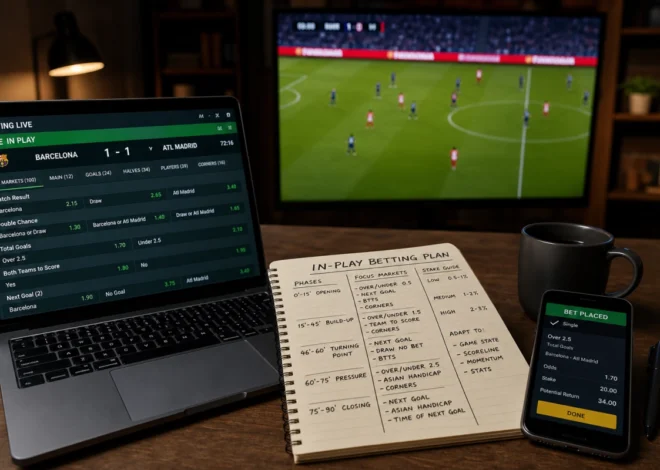
Live betting requires quick, rational checks. A short checklist helps avoid reactive or emotional wagers and focuses on finding the best live betting odds with discipline.
- Score and time: Context matters — a 0–0 at 85′ is different from 0–0 at 10′.
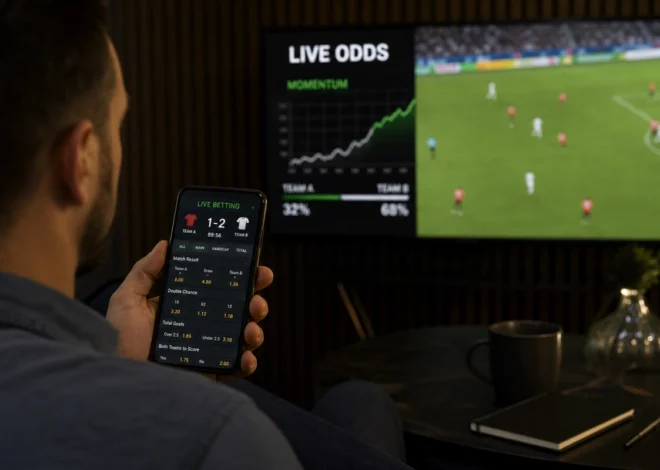
- Momentum cues: Look for attacking sequences, shots on target, transition speed and counter opportunities.
- Live stats: Possession, shots, xG (expected goals), serve win % and break-point opportunities in tennis.
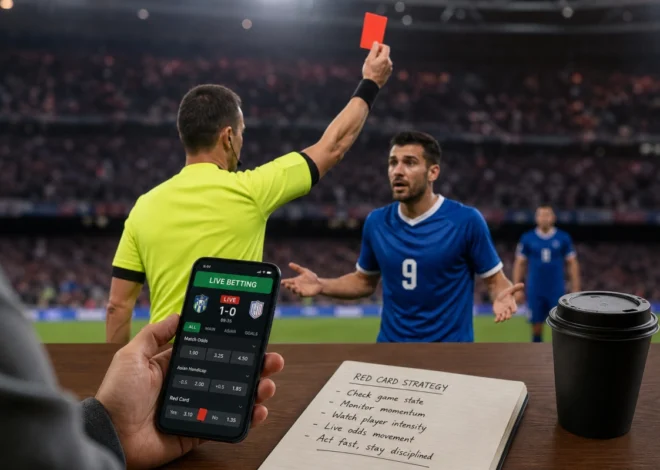
- Personnel changes: Substitutions, rotations, fouls, or injuries that alter tactics or fatigue.
- Market movement: Compare current odds against implied probability and recent line shifts to spot value.
- Liquidity & limits: Large swings can be reactionary; check available stakes and how quickly odds update.
- Emotional filter: Confirm the decision against a pre-set bankroll rule (no chasing losses).
Short, real-match examples to illustrate the checklist
- Football: Team A leads 1–0 at 60′ but Team B has 70% possession and two blocked shots; odds for Team B to score next may shorten—if implied probability is lower than live xG suggests, that’s possible value.
- Basketball: Home team starts a 12–2 run after an opponent’s key player picks up two quick fouls; live handicap and quarter markets often swing—smaller, staged stakes suit volatile runs.
- Tennis: A server with 70% first-serve win rate drops to 45% on the second serve; if break-point chances spike, next-game markets may offer attractive prices for the returner.
Responsible bankroll control is essential. Simple stake-sizing rules follow to keep decisions disciplined and prevent emotional escalation.
Next, the guide will explain concrete stake-sizing rules, show how to convert odds to implied probability quickly, and provide a step-by-step decision flow for each sport so bettors can act calmly and consistently in-play.
Simple stake-sizing rules for disciplined in-play betting
Live markets move fast; your stake plan should be faster and simpler. Use one of these practical, low-friction rules and stick to it:
- Flat-percentage rule: Risk a fixed small percentage of your bankroll per live bet — typically 0.5%–2%. Example: with a $1,000 bankroll, 1% = $10. Use the lower end (0.5%–1%) for highly volatile markets like next-goal or short tennis markets.
- Staged stakes for momentum: When a momentum run is unfolding (e.g., a 12–2 basketball run), split your allocation into 2–3 staged bets instead of one lump sum. This captures continuation without overcommitting if momentum reverses.
- Fractional Kelly (for confident edges): If you estimate a genuine edge, compute Kelly and then use a conservative fraction (25%–50% of full Kelly). This balances growth with protection against estimation error. Never use full Kelly live unless you have proven, repeatable accuracy.
- Maximum-per-event cap: Limit exposure to any single match — e.g., no more than 3%–5% of bankroll across all live bets on that event. This avoids catastrophic loss from one unfolding situation.
- Loss-limits and session discipline: Predefine a session loss cap (e.g., 3%–5% of bankroll). If hit, stop in-play betting for the session to avoid emotional chasing.
Example: bankroll $1,000, choose 1% flat stake. You spot a live value on a football next-goal market at odds 4.0 — stake $10. If you prefer fractional Kelly and compute a 10% full Kelly, apply 25% => 2.5% stake for that opportunity ($25). Pick one method and apply consistently.
Quick mental conversions: odds to implied probability and fast value checks
Speed matters. Convert decimal odds to implied probability with one quick division: 1 ÷ decimal odds. Memorize a few mental anchors for instant checks:
- Odds 1.50 ≈ 67% implied
- Odds 2.00 = 50%
- Odds 2.50 ≈ 40%
- Odds 3.00 ≈ 33%
- Odds 4.00 = 25%
Fast-value test: if your live read (based on xG, possession, serve % or momentum) implies a probability higher than the market’s implied probability, you may have value. Example: football — live xG suggests the trailing team has a 45% chance to score next, but the market shows odds 3.5 (implied ≈ 28.6%). That gap indicates potential value; check liquidity and stake limits, then act with your sizing rule.
For quick Kelly calculation in-play (only if you regularly estimate probabilities): use the formula
Kelly fraction ≈ (odds × your_prob − 1) ÷ (odds − 1)
Then multiply by a conservative fraction (0.25–0.5). Example: odds 3.0, your_prob 0.40 → Kelly = (3×0.4−1)/(3−1) = 0.10 (10%); 25% Kelly = 2.5% of bankroll.
Sport-specific decision flows: concise steps for football, basketball and tennis
These short flows turn the checklist into actionables you can follow under pressure.
- Football (soccer)
- Check score/time, recent xG and attacking sequences.
- Watch substitutions and visible fatigue—full-backs subbed late often signal more pressure on that flank.
- If live xG/possession > market implied probability for “next goal” or handicap swing, consider a staged bet (0.5%–1% per stage).
- Cap exposure on a single match to 3% of bankroll.
- Basketball
- Note fouls, rotations and key players on bench; track recent scoring runs and shot quality.
- For short-run markets (quarter/next 2 minutes), favour smaller stakes (0.5%–1%) and stage if a run begins.
- Use live line moves: large live shifts with little game-change evidence often reflect market overreaction — that’s where value can appear.
- Tennis
- Monitor serve win %, first-serve speed/placement changes and break-point frequency.
- On service woes (first-serve drops or double faults spike), target immediate next-game or next-break markets with reduced stakes (0.5%–1%).
- Use fractional Kelly only when you consistently estimate points/serve-win probabilities well.
These rules and flows create a repeatable, calm approach to live betting: small, disciplined stakes; quick probability checks; and sport-specific cues to identify genuine value rather than reactionary prices.
Your 90-second in-play routine
- Scan score, time and any obvious momentum shifts (attacking sequences, runs of pressure).
- Check one or two live stats relevant to the sport (xG/possessions, shot quality, serve % or rotations).
- Note any personnel changes or visible fatigue that could alter probabilities.
- Convert the displayed odds to implied probability (1 ÷ odds) and run a quick value test against your live read.
- Decide stake using your pre-chosen sizing rule (flat %, staged stakes, or conservative Kelly fraction).
- Place the bet, set a strict event/session cap, and be ready to stop if your loss limit is reached.
Final reminders for disciplined live betting
Live betting rewards calm, consistent process more than clever reactions. Treat every in-play decision like a repeatable experiment: act on measurable cues, size stakes according to plan, record outcomes, and refine your edge over time. Prioritize bankroll protection and session limits — sometimes the best decision is to pass. With practice, focus, and disciplined rules, live markets can become a controlled, testable part of your overall strategy rather than a source of impulsive risk.