
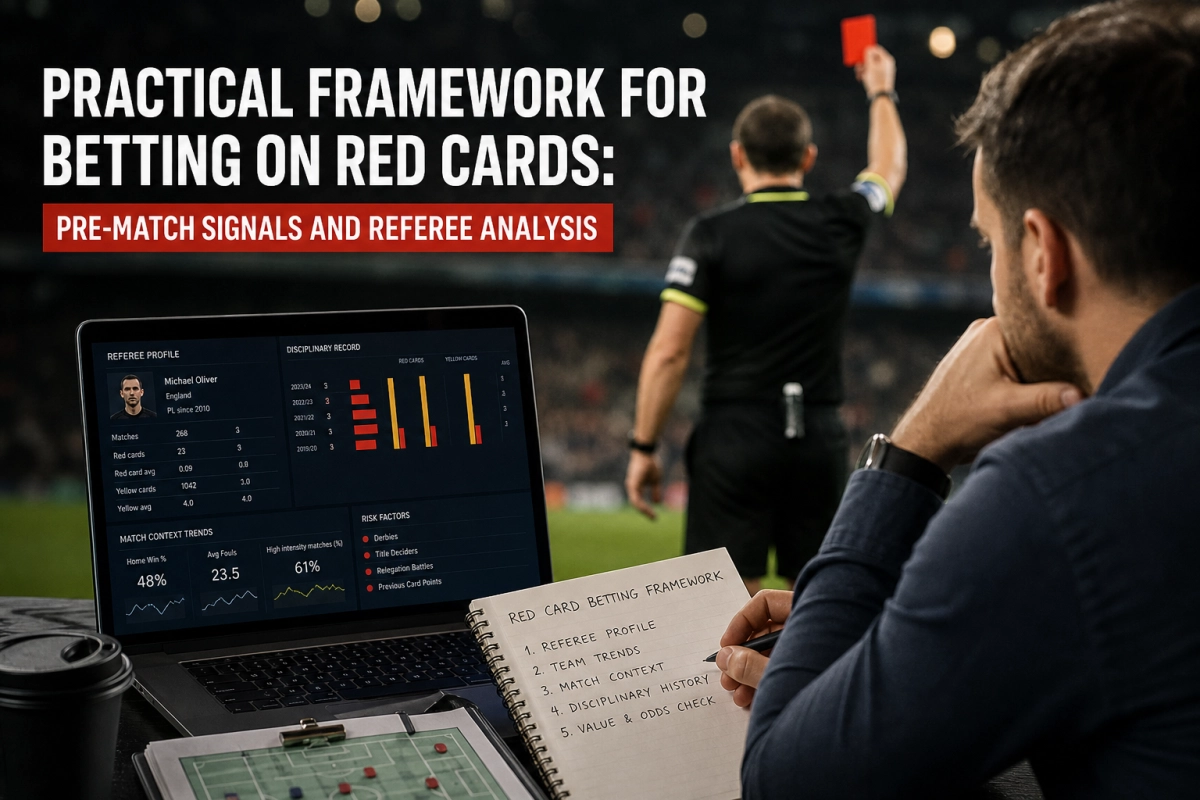
Practical framework for betting on red cards: pre-match signals and referee analysis
Practical framework for betting on red cards before kickoff
Betting on red cards is a niche in live football markets that rewards careful analysis rather than guesswork. This guide explains how to estimate the probability of a red card before a match by combining referee statistics, player disciplinary histories and pre-match context (derbies, rivalries, competition stakes). It also defines essential live-betting terms so beginners and experienced bettors can follow in-play strategy later.
Key concepts: live odds, in-play markets and red-card markets
Before diving into signals, it’s important to know the markets and terminology.
- Live odds — the continuously updated prices offered by bookmakers reflecting changing probability as events unfold.
- In-play markets — betting options available while the match is on: next card, anytime red card, card count, and player-specific cards.
- Cash out — a partial settlement option offered by some bookmakers to lock in profit or limit loss before the market settles.
- Match momentum — pressure, territory and tempo that influence the likelihood of fouls and disciplinary action.
Pre-match signals that move red-card probability
Use pre-match analysis to form a baseline probability. This baseline helps identify value when live odds move during the match.
Referee profile and historical tendencies
- Check the referee’s season averages: yellow and red cards per match, fouls called, and cards in derbies. A referee who averages more yellows and issues occasional reds increases baseline probability.
- Consider international/national differences: some competitions and refereeing crews are stricter.
- Factor in VAR presence and its use for violent conduct or professional fouls—VAR can raise the chance of a retroactive red.
Player and team disciplinary records
- Identify players with high yellow-card rates or prior suspensions—those with a reputation for late tackles or dissent are red-card risks.
- Look at team averages for tackles, fouls committed and cards. Teams that commit many fouls per game are more exposed to an aggressive referee.
- Note defenders or midfield enforcers who are likely to make last-ditch challenges—these positions yield more red-card incidents.
Pre-match context: rivalries, stakes and match tempo
- Derbies and high-stakes matches (relegation, cup ties) typically raise tempers and tensions; the probability of a red can be higher.
- Weather and pitch condition influence sliding tackles and mistimed challenges—soft pitches or heavy rain increase risk.
- Team news: missing key players or a thin bench raises the likelihood of fatigue-driven fouls later in the match.
Combine these pre-match elements into a simple checklist to produce a baseline red-card probability before placing a pre-match wager. Always set a fixed stake relative to bankroll and avoid chasing losses.
Next, the guide will explain how to monitor live-game triggers—minutes, accumulated yellows, substitutions and fatigue—and combine them with the pre-match baseline to make disciplined in-play decisions.
Live-game triggers that materially change red-card probability
Once the match begins, a handful of observable triggers usually determine whether your pre-match baseline should be adjusted up or down. Watch these in real time and treat them as binary inputs that nudge probability rather than absolute predictors.
- Minute bands and fatigue windows — the risk curve is not linear. The first 15 minutes are often calm; the central 20–60 minutes can produce tactical fouls but fewer straight reds; the risk spikes from around 60–75 minutes and again from 80+ as fatigue, desperation and substitutions concentrate contact and mistimed challenges.
- Accumulated yellows (team and player) — two team yellow cards in quick succession make further bookings likelier because the referee has a punitive rhythm. A single player on a yellow is a focal red risk: any late or tactical challenge, handball stopping a goal, or violent conduct later in the game has outsized consequence.
- Substitutions and personnel changes — a fresh defensive substitute tasked with stopping a break, or a hot-headed striker introduced to unsettle the opposition, increases risky challenges. Conversely, the removal of a disciplined center-back can also raise risk if his replacement is inexperienced.
- Momentum shifts and scoreline context — a team trailing by a goal late will commit more desperate tackles; a team protecting a narrow lead may make cynical fouls. Cup ties, extra-time prospects and late VAR reviews amplify tension and red-card chances.
- VAR incidents and reviews — a pending VAR check, late-game offsides and goal-mouth scrums raise the chance of retroactive reds (violent conduct, DOGSO). If VAR is active and a challenge looks borderline, the implied red probability rises.
Operationally, convert these triggers into weighted adjustments: minor triggers (single yellow, 60–69 minutes) add small increments (e.g., +2–4% to your baseline), while compound triggers (player on yellow + fresh attacker + 80+ minutes) justify larger upwards moves (+8–15%). Keep a compact notebook or on-screen checklist so you apply consistent adjustments rather than emotional reactions.
From baseline to bet: disciplined in-play decision rules
With a dynamic probability in hand, you need strict rules to turn it into a wager. The market’s implied probability (1 ÷ decimal odds) tells you whether value exists relative to your estimate.
- Value threshold rule — only bet if your estimated probability exceeds the market-implied probability by a margin (rule of thumb: 20–30%). For example, if you estimate a 15% chance of a red and the market implies 10% (odds 10.0), that 50% relative edge justifies a stake.
- Stake sizing — use a fixed fraction of bankroll per in-play red-card bet (conservative: 0.5–1%; more aggressive: 1–2%). Red cards are high-variance; avoid oversized bets. Consider halving the stake for propositions like player-specific reds and increasing slightly for “red anytime” when multiple triggers align.
- Market selection — prefer “red anytime” or “next card red” if your signal is broad (game-wide tension). Use player-specific markets only when a named player on a yellow or likely to commit DOGSO is involved; those markets pay more but require higher conviction.
- Cash-out and stop rules — predefine exit points. If a small pre-match bet goes up 60–100% quickly and remaining triggers weaken (injury to the hot-headed player, game calms), take the cash. Conversely, if you have a larger in-play position and additional triggers appear, consider holding to settlement.
- Latency and bookmaker behaviour — in fast-moving situations expect slippage. Use providers with low-latency feeds and avoid markets that suspend too easily; note that sportsbooks may restrict players who consistently win on disciplinary markets.
Combine the checklist, numeric adjustments and fixed staking rules into a one-page playbook you follow under pressure. That discipline — not guessing or gut feeling — is the core edge when translating pre-match research into successful in-play red-card bets.
Compact one-page playbook (fill before kickoff)
- Baseline probability — referee + team/player discipline + match context = X% (write number).
- Value threshold — only consider betting if your estimate ≥ market-implied probability × 1.2 (or +20%).
- Trigger adjustments — note minute bands and assign small/medium/large deltas (e.g., +3%, +8%, +12%) for single, compound, and critical triggers.
- Market choice — red anytime for game-level signals; player red for named-player risks; next-card red for immediate situations.
- Stake — fixed fraction of bankroll (0.5–1% conservative); halve for player-specific props unless conviction is high.
- Exit rules — preset cash-out thresholds and stop-loss limits; document when you take or refuse cash-out and why.
- Record-keeping — log pre-match baseline, in-play adjustments, stake, odds taken, outcome and post-match notes for 50–200 bets to establish edge or refute it.
Putting the framework into practice
Treat this as a trading process, not a prediction exercise. Use small, consistent stakes while you validate the edge, focus on clear rules and clean record-keeping, and let empirical results drive incremental changes to your checklist and weighting. Variance will be high; the way you manage bankroll, emotions and adherence to the playbook determines long-term success more than occasional correct calls.
Iterate deliberately: review losing and winning trades to spot systematic errors (overweighting a single signal, slow reaction to substitutions, mistaking emotion for momentum). Referees, team styles and squad availability change over a season, so update baselines regularly and heed pattern shifts rather than isolated outcomes.
Finally, keep discipline paramount. Red-card betting can produce attractive payouts but also sharp swings; preserving capital and consistency in decision-making is the most sustainable edge you can build.