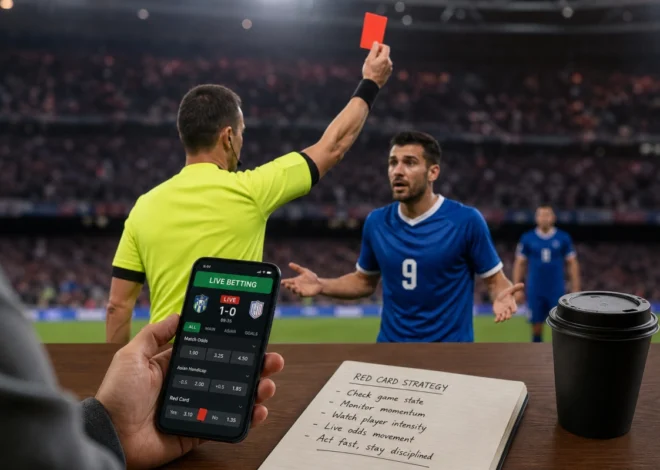

Live Betting Bankroll Management: Sport-Specific Guide to Adjusting Stakes In-Play
How to manage your live betting bankroll while matches change in real time
Live betting bankroll management helps bettors make disciplined, fast decisions during matches. This guide explains key in-play terms, shows how to measure odds volatility, outlines a simple way to estimate a short-term edge, and gives practical stop-loss, profit-target and stake-sizing rules tailored to football, basketball and tennis. The aim is to improve decision quality while emphasising responsible risk control—not to promise guaranteed returns.
Understand live markets, odds movement and key in-play terms
Before changing stakes mid-match, it helps to know the basics:
- Live odds / in-play markets: prices that update as events (goals, fouls, breaks) happen. Markets include match winner, handicap, totals, next goal/point and player props.
- Cash out: a broker-offer to settle a bet early; it reflects current implied probability and your stake exposure.
- Match momentum: short-term shifts caused by events (red cards, scoring runs, break points) that can change win probabilities quickly.
- Handicap / totals / next goal / next point: common live markets that react differently to volatility—know which suit the sport’s tempo.
Good live bettors watch more than the score: look at possession, shots, foul counts, momentum events, substitutions, fatigue and weather where relevant.
Measure odds volatility and estimate a short-term edge
Odds volatility is how quickly and how much prices change. A practical, low-tech way to measure it live:
- Record the market price every 1–3 minutes (or after notable events) and calculate percent change per minute.
- Flag large one-off swings (e.g., >10% change in implied probability) versus sustained drift.
- Compare the market-implied probability to your own short-term estimate — your estimated edge = (your probability) − (market probability).
Examples of short-term estimation by sport:
- Football: after a red card, reduce the disadvantaged team’s win probability sharply; count remaining time and typical expected goal rate before sizing the bet.
- Basketball: a 10–0 run with key players on bench may shift expected points per possession; use timeouts and foul trouble to judge durability of runs.
- Tennis: a player saving multiple break points or showing serve decline suggests momentum; estimate hold/break probabilities from recent service stats and fatigue cues.
Simple stake-sizing and pre-commitment rules
Use conservative, easy-to-apply rules to protect the bankroll and remove emotion:
- Set a session bankroll and a per-bet maximum (common: 0.5–2% of total bankroll for live bets).
- Pre-commit a stop-loss per match/session (example: stop after losing 3% of bankroll in that session).
- Set modest profit targets (example: lock out after gaining 2–5% in a session) and consider partial cash-outs when targets are hit.
- If implied market probability differs from your estimate by a threshold (e.g., ≥5–8 percentage points) consider staking; use smaller stakes for higher volatility.
These rules help avoid chasing and ensure decisions are repeatable. In the next section, the guide will show threshold examples for odds volatility, sport-specific stake tables and a step-by-step betting workflow to use during matches.
Volatility thresholds and stake-adjustment rules
Turn your raw volatility measurement (percent change per minute or per event) into simple action bands. Use three bands that are easy to calculate on the fly:
- Low volatility: <0.5% implied-probability change per minute, or isolated swings <5% that revert. Market is stable; trust larger stakes within your session cap.
- Moderate volatility: 0.5–2% change per minute, or a sustained move of 5–10%. Expect momentum to persist for several minutes; reduce stakes and require a clearer edge.
- High volatility: >2% change per minute, or repeated >10% swings. Markets are noisy—use small stakes, shorter target horizons, and tighter stop rules.
Combine volatility with your estimated short-term edge to arrive at a stake. Keep the math simple so you can act quickly:
- Define a base stake = your per-bet maximum (e.g., 1% of bankroll).
- Define a base edge threshold = the minimum edge at which you’ll use the base stake (e.g., 6 percentage points).
- Adjust stake by two multipliers: edge multiplier = min(2, your_edge / base_edge) and volatility multiplier = 1 for low, 0.6 for moderate, 0.3 for high.
- Stake = base stake × edge multiplier × volatility multiplier.
Example: bankroll = $10,000, base stake = 1% = $100, base edge = 6%. If you estimate a 9% edge and volatility is moderate: edge multiplier = 9/6 = 1.5, volatility multiplier = 0.6 → stake ≈ $100 × 1.5 × 0.6 = $90.
This rule keeps stakes dynamic but bounded. It increases exposure when your edge is meaningfully higher than your standard threshold, while cutting exposure during noisy periods.
Sport-specific stake tables and an in-play betting workflow
Below are concise sport-specific guidance and a practical step-by-step workflow to use during matches. These are templates—calibrate numbers to your risk tolerance.
Football (soccer)
- Base stake: 0.75–1.25% of bankroll. Use the lower end for long remaining time, higher when little time remains and momentum is clear.
- Edge threshold: 6–8 percentage points for match-winner; 5 points for next-goal markets.
- Volatility notes: Red cards and late substitutions create high volatility—drop stake to 25–50% of base.
- Stop/profit: per-match stop-loss 1–2% of bankroll; take-profit when session gain reaches 2–4%.
Basketball
- Base stake: 1–2% (possession-based game, faster pricing).
- Edge threshold: 5–7 points (look at expected points per possession shifts).
- Volatility notes: A 10–0 run or key player foul trouble is moderate volatility—use 50–75% of base; early/late-game swings with timeouts are high volatility—use 25–40%.
- Stop/profit: per-game stop-loss 2–3%; consider smaller time-window targets (e.g., profit on a single quarter).
Tennis
- Base stake: 0.5–1.5% depending on level (lower for long best-of-3 matches, higher for short sets/tiebreak-driven markets).
- Edge threshold: 6–8 points for match/next-game; 4–6 for immediate point markets if you’re confident.
- Volatility notes: Break-point sequences are high-volatility events—use minimal stakes; if a server shows clear decline, moderate confidence and increase to 75% of base.
- Stop/profit: per-match stop-loss 1–2%; take profit after single-leg trade returns 30–50% of potential max profit via partial cash-out.
Step-by-step live workflow (use as a checklist)
- Start: confirm session bankroll and per-bet max. Note pre-commit stop-loss and profit target for the session.
- Measure: log market price every 1–3 minutes or after notable events; classify volatility band.
- Estimate edge: quickly update your short-term probability (use recent event context—red card, run, break points, substitutions).
- Decide: if edge < base edge, do not stake. If edge ≥ base, compute stake using the multipliers (edge and volatility).
- Execute: place bet and set an immediate plan—target profit level and a hard stop (time-based or loss-based). Consider partial cash-out rules (e.g., cash out 50% at +50% of quoted profit).
- Manage: if market reverses and breach stop, close position immediately. If profit target hit, lock gains partially or fully according to your rule.
- Review: end of session, log outcomes and compare estimated edge vs actual result to recalibrate your thresholds.
Following these sport-specific rules and the workflow keeps live betting disciplined, repeatable and aligned with bankroll protection. In Part 3 we’ll cover sample spreadsheets for tracking, how to backtest these rules, and ways to refine your edge estimation over time.
Practical tracking and backtesting
Before you scale stakes, keep a clean, minimal log and run simple backtests so your live rules prove out in real conditions.
- Suggested spreadsheet columns: date, sport, match, market, timestamps of odds snapshots, market implied probability, your estimated probability, calculated edge, volatility band, stake placed, cash-out actions, result, P/L, and short notes on context (red card, run, injury).
- Backtest approach: collect a rolling sample of live opportunities (start with 100–300 rows). Apply your stake rule retroactively to compute hypothetical P/L, hit rate and drawdowns. Track how realized edge compares with estimated edge and adjust base-edge and multipliers accordingly.
- Practical thresholds: if your simulated drawdown or variance exceeds your comfort level, reduce base stake or tighten edge thresholds rather than chasing higher returns.
- Iterate in short cycles: test changes for a few dozen spots, review, then adjust. Keep all changes small and documented so you can identify what moved performance.
Putting it into practice
Live betting is fast and sometimes chaotic. The most reliable edge you can build is procedural: a simple measurement routine, transparent stake rules, disciplined stop-losses and an honest log of outcomes. Start small, treat the first sessions as experiments, and focus on protecting your bankroll while you learn how markets behave in real time.
Over time, aim for incremental improvements—cleaner probability estimates, sharper volatility reads and steadier execution—rather than chasing big wins. If at any point emotional pressure pushes you to deviate from your rules, step away and review the data before returning. Responsible sizing and consistent record-keeping will let you know whether your approach is working long before you commit meaningful capital.

Related Posts

How to Evaluate the Best Live Betting Odds: A Practical In-Play Checklist for Matches
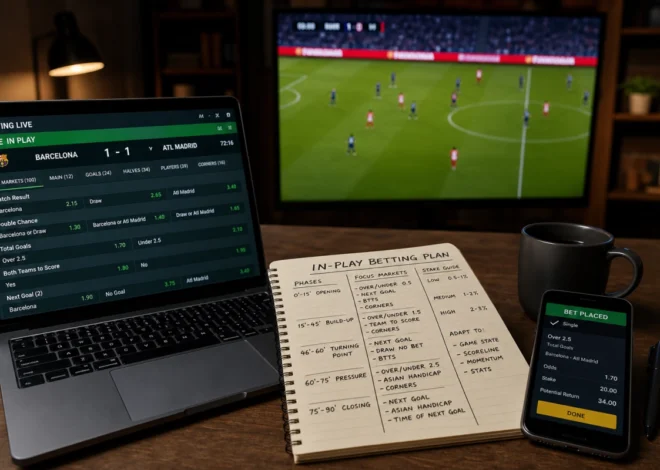
Practical Phase-by-Phase In-Play Betting Guide — Which Markets to Prioritise and How to Size Bets