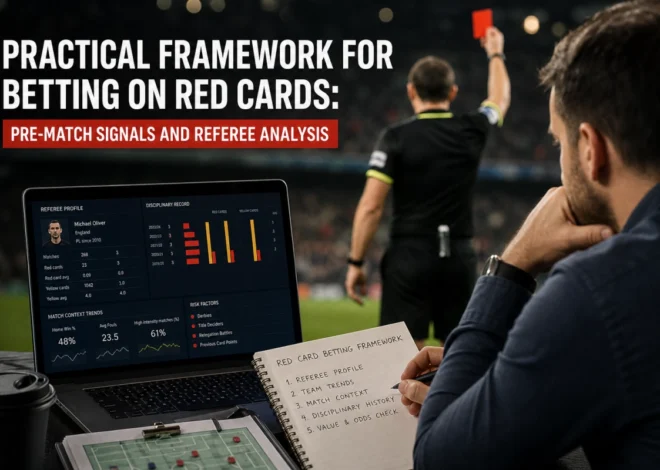

The Best Sports Betting Strategies: A Complete Beginner’s Guide
Why having a strategy changes how you bet
When you first place a sports bet, it can feel like guessing. Without a plan, you risk emotional decisions, chasing losses, and diluting any edge you might have. A clear strategy turns betting from a series of chance-based wagers into a disciplined process. You’ll make choices based on probability, value, and risk management rather than impulse.
As a beginner, your goal should be to preserve capital and learn how the market moves. That means focusing on a few core concepts before trying complicated systems or high-stakes parlays. The sections below give you the foundational skills you need to bet responsibly and start recognising opportunities that offer real long-term value.
How odds and markets determine value
Understanding odds is the first step to identifying value bets. Odds express the market’s view of an outcome and determine how much you win. You’ll encounter three common formats:
- Decimal odds: Easy to calculate returns — multiply your stake by the decimal number.
- Fractional odds: Common in the UK — show profit relative to stake (e.g., 3/1).
- Moneyline/American odds: Indicate how much you must stake or stand to win $100.
Value exists when your estimated probability of an outcome is higher than the probability implied by the bookmaker’s odds. For example, if you believe a team has a 40% chance to win but the odds imply only a 30% chance, that bet contains value. Your job is to develop methods to estimate probabilities better than the market, or at least find discrepancies you can exploit.
Basic ways to spot value
- Compare odds across multiple bookmakers to find the best price.
- Use simple models or head-to-head statistical analysis for the leagues or sports you follow.
- Factor in situational elements (injuries, travel, motivation) that markets may underweight.
Protecting your bankroll with smart staking
Bankroll management is where many beginners fail. Decide in advance the amount of money dedicated solely to betting — your bankroll — and accept that it’s money you can lose without affecting daily life. From there, choose a staking strategy that preserves that bankroll while allowing steady growth.
- Flat staking: Bet a fixed percentage or amount on each wager. It’s simple and controls risk.
- Percentage staking: Use a small percentage (1–3%) of your bankroll per bet so stakes scale with wins and losses.
- Unit system: Assign a unit size that represents a small portion of your bankroll and bet in whole units to simplify tracking.
Avoid aggressive progressive systems (e.g., Martingale) as a beginner — they can wipe out your bankroll after a few losing streaks. Track every bet, review results periodically, and adjust unit sizes only when your bankroll has meaningfully changed.
With the basics of odds, value, and bankroll management in place, you’re ready to learn methods for researching bets and building simple models that give you an edge — the next section will walk you step-by-step through research techniques and practical tools to improve your selections.
How to research a single bet: a step-by-step routine
Having a repeatable process turns ad‑hoc picks into reproducible decisions. Use this checklist every time you consider a wager — it’s short, practical, and helps you avoid emotional traps.
- Define the market and objective: Are you betting a match result, total points, spread, or a prop? Different markets require different information.
- Gather the basic facts: Lineups/injuries, recent form (last 5–10 contests), head‑to‑head results, rest days, travel, and weather if relevant. Verify start times and any late team news.
- Check situational context: Motivation (must‑win game, cup tie, rotation), scheduling congestion, coaching changes, and home/away splits. Markets sometimes underreact to these factors.
- Look at advanced signals: For soccer, expected goals (xG) and shot volume; for basketball, offensive/defensive efficiencies; for tennis, surface win rates and recent match length. These metrics often reveal performance trends raw results conceal.
- Compare prices across books and exchanges: Find the best available odds and note market movement — sharp early moves or late swings can indicate informed money.
- Estimate your probability and decide stake: Convert your model or judgement into a probability, translate that to fair odds, and only bet when the market price represents value. Size the stake using your staking plan.
- Record the bet and rationale: Log stake, odds, your estimated probability, and why you took it. This makes later review meaningful.
Follow these steps consistently. Over time you’ll see which inputs matter most for the sports you follow and where you can shortcut the process without degrading accuracy.
Building simple models and tools that actually help
You don’t need advanced statistics to gain an edge — well‑constructed, simple models often outperform flashy but overfitted systems. The aim is to generate an independent probability estimate you can compare with market odds.
- Start with a spreadsheet: Track raw metrics (goals scored/conceded, shots, saves, turnovers) and compute rolling averages. Spreadsheets are transparent and easy to backtest against historical odds.
- Use basic predictive methods: Moving averages for short‑term form, Poisson models for low‑scoring sports (soccer totals), and ELO or simple power ratings for head‑to‑head strength. These methods are interpretable and quick to implement.
- Convert outputs to probabilities: Turn model scores into implied probabilities (e.g., normalize ELO win expectations). Then compare with bookmaker implied probability (1/odds minus vig) to spot value.
- Backtest sensibly: Test your model over several seasons or samples. Look for consistency in return on investment and hit rate, not just single big wins. Beware of small sample overfitting.
- Use free tools and data sources: Odds comparison sites, league statistic pages (FBref, Basketball‑Reference, Baseball Savant), and betting exchange prices give useful inputs. APIs and CSV data downloads help automate updates later.
Finally, refine incrementally. Add one new variable at a time, re‑evaluate performance, and only keep changes that improve predictive power. Simplicity plus consistent tracking beats complexity without discipline.
Reviewing your performance
Make reviewing bets a regular habit rather than an occasional chore. A short, consistent review process helps you separate skill from luck and shows where to focus improvements.
- Set a schedule: review weekly for short‑term adjustments, monthly for trends, and seasonally for model changes.
- Track core metrics: ROI (return on investment), yield, strike rate, average odds, and edge (your estimated probability vs. market odds).
- Log qualitative notes: why you placed each bet, what you learned from wins and losses, and any repeated mistakes.
- Use reliable data sources to validate assumptions — for match and player stats try FBref to populate spreadsheets and backtests.
- Make one change at a time: test it, measure impact, and rollback if it reduces performance or increases variance without benefit.
Responsible betting and the right mindset
Betting successfully is as much about temperament as it is about numbers. Accept variance, avoid impulse plays, and prioritize preserving capital and clarity of thought.
- Set firm limits on bankroll, time, and session stakes — treat them as non‑negotiable rules.
- Don’t chase losses; take breaks after losing runs and revisit your process before increasing stakes.
- Focus on learning: every bet should teach you something about markets, models, or your own psychology.
- If gambling is causing stress or harm, seek help early and consider self‑exclusion or professional support.
Staying disciplined for the long run
Successful betting is a marathon, not a sprint. Keep your approach simple, protect your bankroll, and commit to continuous learning. Over time, disciplined process and honest review will do far more for your results than chasing shortcuts or big‑risk systems. Bet small, think long, and let consistency — not luck — be the measure of your progress.